

There's nothing worse than starting your day with a dribbling, lukewarm shower. It's one of those little frustrations that can just set a bad tone for everything else. But before you start thinking about expensive plumbing overhauls, the good news is that the fix is often surprisingly simple.
A lot of the time, all it takes is a few basic checks, like cleaning mineral buildup from your showerhead or just making sure all the water valves are fully open. These quick jobs can often bring your shower back to life without you needing to call in a professional. As experienced Melbourne plumbers, we know that sometimes the simplest solution is the right one.
Diagnosing Your Low Shower Pressure
Alright, let's play detective for a minute. A weak shower isn't a problem in itself; it's a symptom. And like any good detective, you need to follow the clues to find the real culprit before you can fix it. Getting to the root of your low water pressure is the absolute first step to getting back that powerful, satisfying shower you're missing.
The biggest clue is figuring out if the problem is isolated. Is it just the shower giving you grief, or are all the taps in your house struggling?
If it's only the shower, you're likely looking at a localised issue like a clogged showerhead—a really common headache for us here in Melbourne. But if the weak pressure is house-wide, the problem is probably closer to your main water supply. If you're looking for a plumber near me to diagnose the issue, a professional can quickly identify the source.
This decision tree gives you a great visual guide to start narrowing things down.
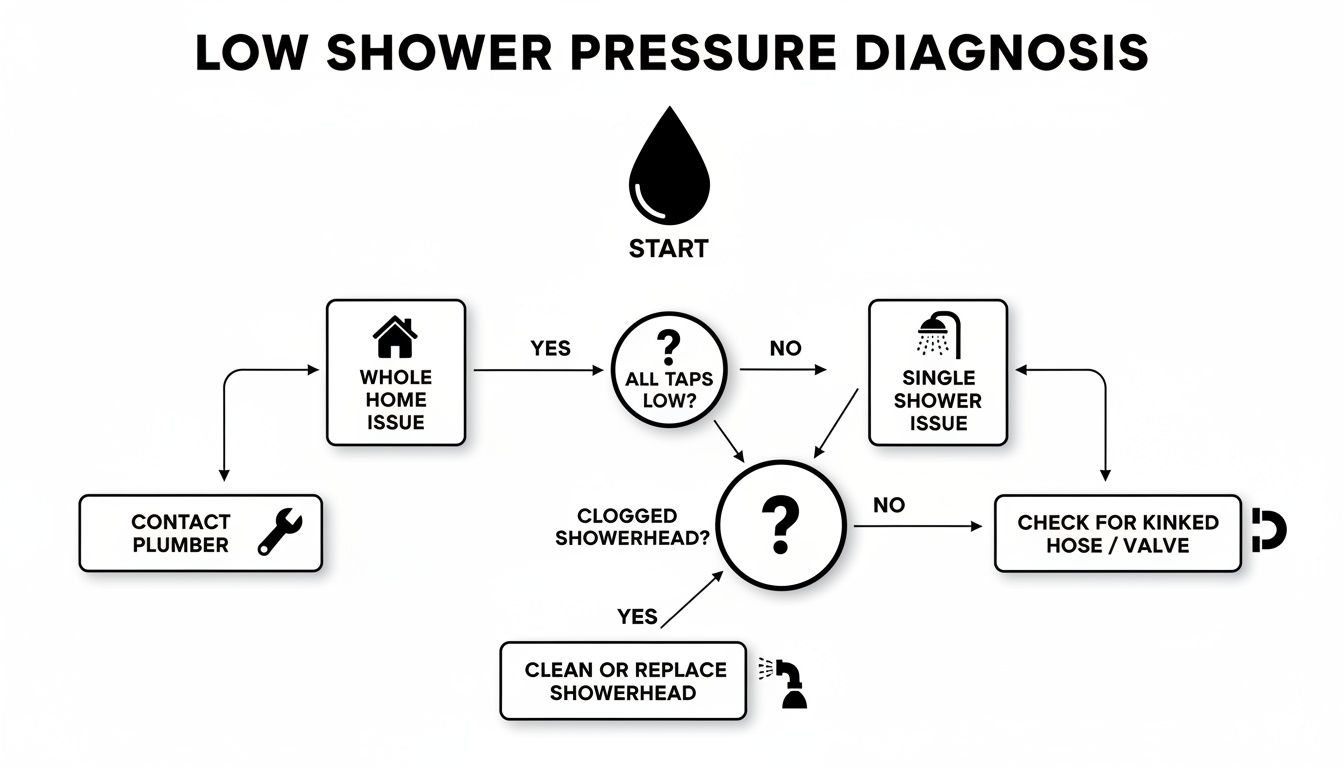
As you can see, figuring out if it's one fixture or the whole house is the most efficient way to kick off your troubleshooting.
Common Culprits in Melbourne Homes
Here in Melbourne, especially in established suburbs like Balwyn or Kew, we often find that older plumbing is a major factor. The standard water pressure for Melbourne homes should be somewhere between 300 and 500 kPa.
Yet, we see that up to 40% of households in metro Melbourne, particularly in older eastern suburbs homes built before 2003, have showers dipping below that 300 kPa mark. The usual suspect? Pressure reduction valves (PRVs). Over time, they get clogged with mineral deposits from our hard Victorian water, which can slash the flow by as much as 30-50%. A qualified plumber in Melbourne can assess if your PRV is the cause of the problem.
A simple way to get a baseline reading is to perform a quick test at home. Understanding your home's current pressure can immediately tell you if the problem is system-wide or isolated to your bathroom. For detailed instructions, check out our guide on how to test water pressure at home.
Easy Fixes You Can Tackle in Under an Hour
Is a weak, dribbling shower ruining your morning? Before you even think about calling a plumber, take a breath. There are a couple of incredibly common culprits you can check and fix yourself, usually with minimal tools and time.
These simple jobs often get your shower’s power right back to where it should be.
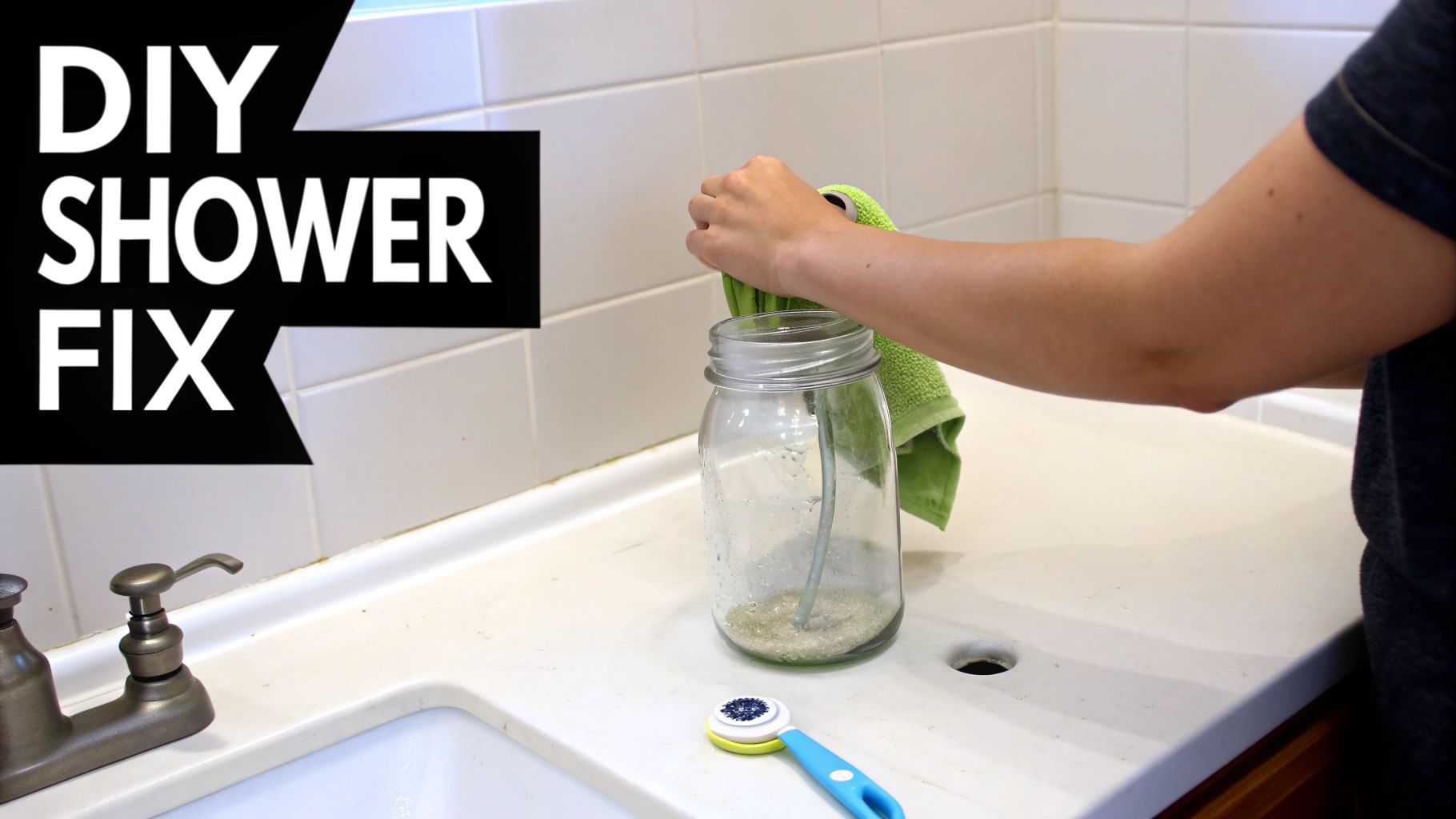
Often, the problem isn’t buried deep in your pipes. It's right at the end of the line—the showerhead itself. Over time, it gets clogged up, but clearing it out is a straightforward task.
Descale Your Clogged Showerhead
Melbourne’s water is notoriously hard. This just means it’s full of minerals like calcium and magnesium. While it's perfectly fine to drink, these minerals love to build up inside your showerhead’s tiny nozzles, creating a chalky gunk called limescale that slowly chokes off the water flow. This can often be mistaken for a major plumbing issue requiring an emergency plumber in Melbourne.
Luckily, giving your showerhead a good clean is dead simple and surprisingly effective. All you really need is some white vinegar, a plastic bag, and a rubber band.
- Get it submerged: Grab a plastic bag and pour in enough white vinegar to completely cover the nozzle end of your showerhead.
- Secure and soak: Use a rubber band to tie the bag in place, making sure all the little spray holes are soaking in the vinegar. Let it sit for at least an hour—or even overnight if you’ve got some serious buildup.
- Scrub and rinse: Take the bag off and use an old toothbrush to scrub away any loosened mineral deposits from the nozzles. Then, turn the shower on full blast for a minute to flush everything out.
That simple vinegar bath works wonders by dissolving the limescale and clearing the path for the water. You should notice an immediate difference.
If you’ve cleaned the showerhead and the pressure is still low everywhere in the house, it could point to a bigger issue in your plumbing system. We get into those system-wide problems in more detail here if you find you have no water pressure in your house.
Remove the Water Flow Restrictor
To meet water conservation standards, most modern showerheads come fitted with a flow restrictor. It's just a small plastic or rubber disc, often a bright colour, tucked inside the showerhead’s connection point. Its only job is to limit how much water can pass through.
While it’s great for saving water, it can also make your shower feel disappointingly weak.
Taking it out is a safe, reversible way to get more water volume, which gives you that feeling of higher pressure. You'll need to unscrew the showerhead from the shower arm. Look inside the threaded end—you should see a small, perforated disc. You can usually pry it out gently with a paperclip or a small flathead screwdriver.
Once it's out, screw the showerhead back on, and you’ll likely feel a much more powerful spray. Just keep in mind this will increase your water consumption.
If giving your showerhead a good scrub didn't get the water flowing again, it’s time to look at the bigger picture. The problem might not be in your bathroom at all, but somewhere in your home's main water supply. A quick investigation here can often uncover a simple, overlooked issue.
It’s surprisingly common. After some plumbing work gets done, or even after council maintenance in your street, a valve might not have been fully reopened. This creates a bottleneck for your entire home, restricting the water volume and causing that disappointing drop in pressure.
Find Your Main Shutoff Valves
Every house has a couple of key valves that control the water flowing from the street to your taps: the main shutoff valve and the water meter valve. If either of these is even partially closed, you'll feel it everywhere, not just in the shower.
- The Main Shutoff Valve: You'll usually find this inside or on an outside wall where the main water pipe enters your house. In a typical Melbourne home, good places to look are the laundry, under the kitchen sink, or in the garage. Give the handle a check – you want it turned fully anti-clockwise to be completely open.
- The Water Meter Valve: This one is outside, near your property line, usually under a little plastic or metal lid in the ground. Your water meter has a valve on the side closest to your house. It’s crucial to make sure this is also fully open.
Honestly, it’s a great idea for every homeowner to know exactly where these valves are before you have an emergency. If you can't find them, a professional plumber in Doncaster can point them out for you during a routine visit.
What About Your Pressure Reducing Valve (PRV)?
Many Melbourne homes, especially in suburbs with high mains pressure, have a Pressure Reducing Valve (PRV) fitted. It's a bell-shaped gadget, normally installed near your main shutoff valve. Its job is exactly what it sounds like: it tones down the high pressure from the street to a safer level for your home’s pipes and appliances.
While they’re great for protecting your plumbing, a PRV can also be the villain in your low-pressure story. They can fail over time, get clogged up with sediment, or might just be set too low. If you've noticed the pressure slowly getting worse over a few months, or if it feels weak all through the house, a dodgy PRV is a prime suspect.
You can adjust a PRV yourself by loosening a locknut and turning a screw, but getting it wrong can send pressure spikes through your system and cause real damage. If you think the PRV is the culprit, it's much safer to have a professional Melbourne plumber check it out. We can test the pressure accurately and make the right adjustments without any risk.
When Your Hot Water System Is the Problem
If you’ve noticed your shower pressure drops the second you turn up the heat, you've probably found your culprit. It’s a classic sign. The issue isn’t coming from the street, but from your hot water system itself.
We see this a lot in Melbourne homes. The heater, whether it's a big storage tank or a sleek instantaneous unit, can easily become a bottleneck in your plumbing.
Diagnosing Storage Tank Heaters
Those traditional storage tank hot water systems, common throughout the eastern suburbs, have a habit of collecting sediment over time. All those minerals and bits of debris from the mains water supply settle at the bottom of the tank, eventually forming a thick, sludgy layer.
This gunk can seriously restrict the flow of water leaving the tank. It basically chokes the pressure before it even gets a chance to head towards your shower. Sometimes, the outlet pipe itself can get partially clogged with this build-up.
Another sneaky issue we often find is corrosion inside older steel pipes connected to the heater. Rust and scale can flake off and create blockages. Thankfully, modern pipe relining Melbourne solutions can often fix this by restoring flow without having to dig up your yard.
Issues with Instantaneous Systems
Instantaneous systems are brilliant for energy efficiency, but they aren’t bulletproof when it comes to pressure. These units have inlet and outlet valves that can sometimes be left partially closed, maybe by accident or after a previous service call. If a valve isn't fully open, you'll feel it in the shower straight away.
A simple kink in the flexible copper or braided steel line connecting the unit is another common culprit. This is especially true if the system has been recently installed or serviced. For a deeper dive, check out our guide on what to do when your hot water system is not working for more detailed steps.
Figuring out these specific problems takes a good eye and a solid understanding of both plumbing and gasfitting. If you suspect your hot water system is behind your weak shower, it’s usually best to get a professional to take a look. Our expertise in gasfitting in Melbourne ensures we can handle any system.
A licensed plumber can safely inspect your unit, check for sediment, make sure all the valves are set right, and spot any hidden blockages in the pipes. For expert help diagnosing your hot water system in Balwyn, Doncaster, or anywhere in Melbourne's eastern suburbs, the team at Amari Plumbing has the specialised skills you need.
So, you’ve cleaned the showerhead, double-checked every valve you can find, and even made sure your hot water system isn't the problem… but the shower pressure is still just a pathetic dribble. If you've exhausted all the simple DIY fixes, it's time to face the fact that the issue might be deeper in your plumbing system.
When the usual tricks don't work, it often points to a problem that needs more than just a bit of elbow grease. This is especially true for older homes or properties in hilly areas. We're now moving into the territory of significant plumbing upgrades, like installing a water pressure booster pump or dealing with old, tired pipework.
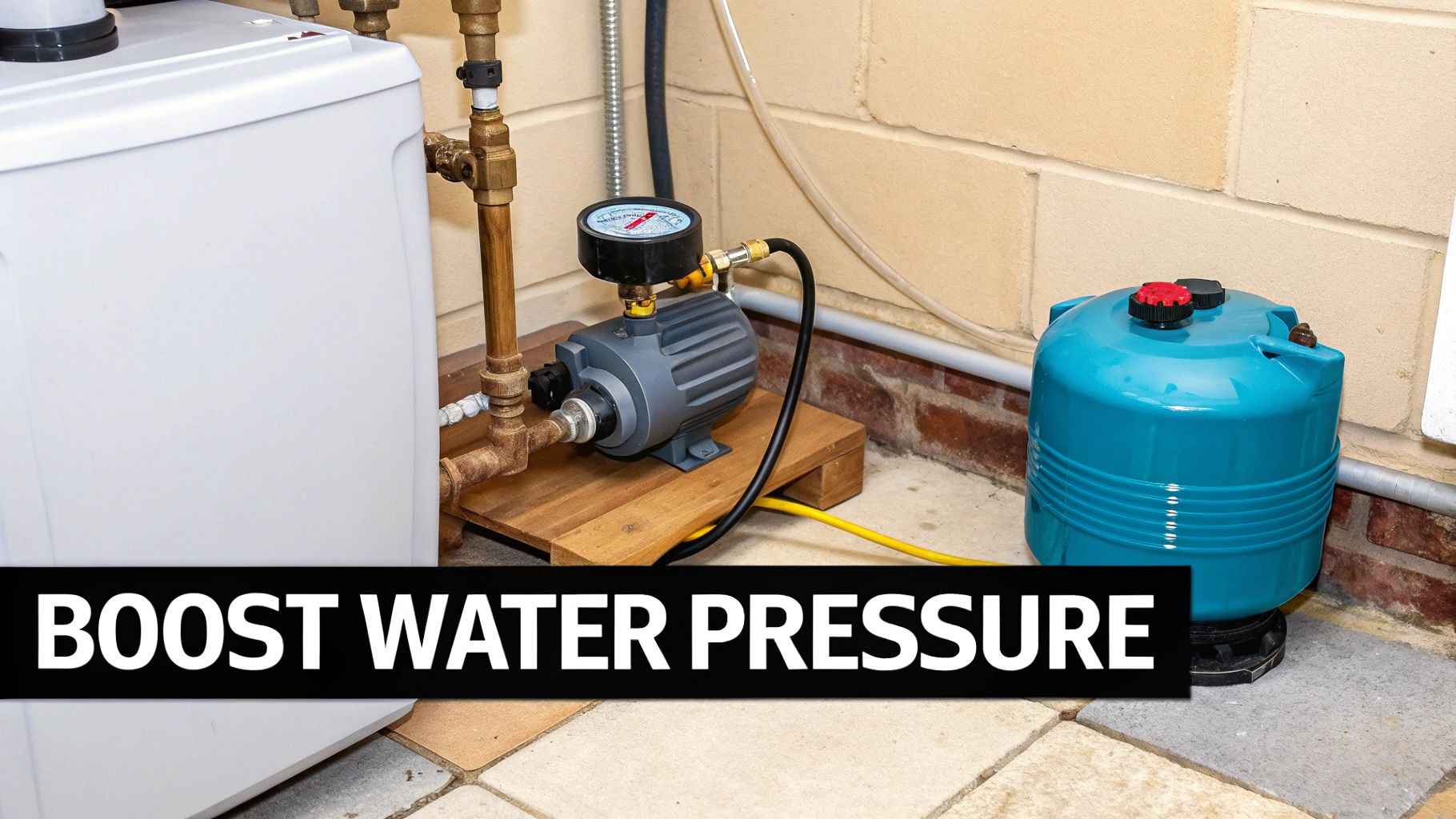
Knowing when to call in the professionals is the key to finally getting that satisfying shower pressure you've been dreaming of.
Installing a Water Pressure Booster Pump
Sometimes, low water pressure isn't actually a "problem" with your plumbing but a simple fact of your location. For many Melbourne homes, especially those on a hill, at the end of a long municipal supply line, or in an upper-floor apartment, the mains pressure just isn't strong enough to give you a powerful flow.
In these situations, a water pressure booster pump is often the perfect fix. It’s a specialised device we install on your main water line that actively increases the pressure of the water before it even enters your home’s plumbing.
Think of it like a turbocharger for your water. An internal impeller spins and forces water through your pipes with more oomph, guaranteeing a strong, consistent flow to every tap and shower. It’s a targeted solution that directly solves the problem of weak incoming pressure.
The Problem With Old Galvanised Pipes
Another classic culprit, particularly in beautiful older Melbourne suburbs like Kew and Hawthorn, is outdated galvanised steel pipes. Back in the day, they were the standard. The big downside? They corrode from the inside out over time.
This gradual buildup of rust and scale slowly narrows the pipe's internal diameter, effectively strangling the water flow. If your house was built before the 1970s and has never had a plumbing overhaul, there's a very good chance your old pipes are the reason for that frustratingly weak shower.
A full repipe sounds like a massive headache, but modern plumbing has come a long way. Our expertise in pipe relining in Melbourne means we can often create a brand-new, seamless pipe inside the old one. It’s a fantastic way to fix blockages and restore flow without having to dig up your whole property.
DIY Fix vs Professional Plumber: When to Call for Help
It can be tempting to have another go yourself, but some plumbing issues really do need a professional touch to avoid making things worse. Here’s a quick guide to help you decide when to put down the tools and pick up the phone.
| Problem | Recommended Action | Why Call a Pro |
|---|---|---|
| Clogged Showerhead | DIY Fix | A simple soak in vinegar and a good scrub is usually all it takes to clear mineral buildup. |
| Faulty PRV | Call a Professional | Adjusting this incorrectly can cause dangerous pressure spikes and damage your entire system. |
| Suspected Pipe Corrosion | Call a Professional | This needs a proper camera inspection and specialised services like sewer relining to fix properly. |
| Low Mains Pressure | Call a Professional | Installing a booster pump involves licensed plumbing and electrical work. It's not a DIY job. |
For these more complex jobs, you need an experienced plumber who’s seen it all, from big commercial plumbing projects to tricky residential systems. If you're dealing with stubborn low pressure in Balwyn, Doncaster, or the nearby eastern suburbs, it's time to let us take a look.
Tired of a shower that just can't deliver? It might be time for an expert diagnosis. Contact Amari Plumbing and Gasfitting today and let's get it sorted for you.
Still Got a Weak Shower? Let Melbourne's Experts Take a Look
So, you’ve cleaned the shower head, checked the valves, and maybe even had a look for a flow restrictor. If your shower is still more of a sad trickle than a powerful stream, it’s a pretty clear sign the problem runs deeper than a simple DIY fix.
Don’t resign yourself to disappointing showers. It’s time to call in the professionals.
At Amari Plumbing and Gasfitting, we’re the go-to team for homeowners dealing with exactly these kinds of frustrating issues across Melbourne’s eastern suburbs, from Hawthorn to Camberwell. As your local Melbourne plumbers, we’ve seen it all and know the ins and outs of the plumbing systems in our area. We’re all about fast, reliable service with transparent, fixed pricing that we’ll discuss with you right over the phone. No surprises. When you find a plumber with us, you're choosing reliability.
We’re big believers in getting the job done right the first time. That’s why all our work is backed by a 3-month workmanship warranty, giving you total peace of mind.
Getting in touch is easy. Here’s a quick look at our straightforward contact page.
Just fill out the simple form for a quick callback, or grab our number if you need an immediate chat.
For a free, no-obligation estimate over the phone, contact us today. Let our reliable team get to the bottom of your water pressure problems and solve them for good.
A Few Lingering Questions About Shower Pressure
We've walked through a lot of potential fixes, but I find clients often have a few specific questions still buzzing in their heads. Let's tackle some of the most common ones we hear from homeowners around Melbourne.
What's the Real Cost to Fix Low Water Pressure in Melbourne?
This is the big one, and the honest answer is: it really depends on what's causing the problem.
If it's just a gunked-up showerhead, your only cost is a bit of time and some vinegar from the pantry. But if the culprit is a failing valve, old corroded pipework, or you need something like a booster pump installed, that’s when you need to call in a professional. Problems like blocked drains can also impact pressure and require expert attention.
Here at Amari Plumbing and Gasfitting, we hate surprises as much as you do. For many of the usual suspects, we can give you a fixed price right over the phone. You'll know exactly what you're up for before we even set foot in your home.
Will a New Showerhead Actually Increase My Water Pressure?
This is a common misconception. A new "high-pressure" showerhead can't magically boost the pressure coming out of your wall. What it can do is make the water feel a whole lot stronger.
Think of it like putting your thumb over the end of a garden hose. These showerheads are cleverly designed with smaller, more focused nozzles. They force the same amount of water through a tighter space, which makes the spray feel more powerful and satisfying. It’s a great trick, but just remember it's a workaround, not a fix for a deeper issue like a hidden blockage or a dying valve.
Why Is It Only My Shower That Has Pathetic Pressure?
If the kitchen tap is fine and the bathroom sink is gushing, but your shower is just a sad trickle, you can be pretty confident the problem is right there in the bathroom.
Nine times out of ten, the issue is a clogged showerhead or a blocked flow restrictor inside it. Melbourne's hard water is notorious for leaving mineral deposits that build up over time. Every so often, it might be a faulty mixing valve (the bit inside the wall you control with the handle), but always start with a good, thorough clean of the showerhead itself.
Is It Okay to Take the Flow Restrictor Out of My Showerhead?
Yep, it's generally safe to remove it. That little plastic disc is put there by the manufacturer to meet water conservation standards, basically to limit how much water you use per minute.
Popping it out will let more water through, which almost always results in what feels like better pressure. Just be mindful that your water consumption—and your water bill—will go up as a result.
If you’ve given these a crack and you’re still stuck with a disappointing drizzle, Amari Plumbing and Gasfitting can get to the bottom of it. Our experienced Melbourne plumbers will find the real cause and get that powerful shower you're dreaming of back online. Contact us today for a chat and a no-obligation estimate over the phone.