

That tell-tale soggy patch on your lawn or the sudden jump in your water bill isn't just an inconvenience. It’s a pretty clear sign you need to figure out how to find a water leak underground. A hidden leak can waste thousands of litres of water, send your bills through the roof, and even cause serious structural damage to your property if left unchecked.
Why Underground Leaks Are a Serious Problem for Melbourne Homeowners
An underground water leak is one of those sneaky problems. Because it's out of sight, it can silently cause a world of hurt to your property and your wallet for weeks, sometimes months, before you even realise what's happening. For homeowners in Melbourne, especially in established eastern suburbs like the clients of a plumber in Balwyn or a plumber in Doncaster, where the plumbing has been around for a while, the risks are even higher.
The problem often starts small. Leaks aren't always the dramatic pipe bursts you see in movies. More often than not, they’re the result of slow, persistent issues that build up over time. If you need an emergency plumber in Melbourne, it's often due to a small issue escalating.
Common Causes of Hidden Leaks
We see a few common culprits again and again when we're called out to investigate.
- Ageing Pipes: Older galvanised iron or copper pipes eventually start to corrode. It's just a matter of time. This can lead to tiny pinhole leaks that only get worse.
- Shifting Soil: Anyone living in Melbourne knows about our reactive clay soil. It expands and contracts with the weather, putting a huge amount of stress on buried pipes, which can cause them to crack or for joints to fail.
- Tree Root Intrusion: Trees are incredibly persistent when they're looking for water. Their roots can force their way into tiny cracks in your pipes and slowly push them apart as they grow, often leading to blocked drains.
- Poor Installation: Unfortunately, not all plumbing work is created equal. A dodgy installation job from years ago can mean joints fail or pipes aren't aligned properly, creating a weak spot just waiting to spring a leak.
The Real Risks You Face
This goes way beyond just a high water bill. An ongoing underground leak can completely saturate the soil around your home’s foundation. This compromises its structural integrity and can lead to serious issues like cracks in your walls or floors. Believe me, fixing that kind of slow-burn damage is often way more expensive than repairing the leak itself. A professional Melbourne plumber can assess the situation accurately.
And in a city that's conscious of its water usage, the waste is a real environmental concern. A leak that loses just a few litres an hour adds up to tens of thousands of litres over a year—a resource Melbourne simply can't afford to waste.
A persistent, small leak can cause the soil to erode around your pipes, which might eventually lead to sinkholes or significant foundation damage. Addressing it early isn’t just about saving money on water; it’s about protecting your entire property.
Ignoring the early signs is a massive gamble. What starts as a minor drip can quickly escalate into a full-blown plumbing emergency, needing major excavation work and some very costly repairs. Understanding what’s at stake is the first step. If you suspect you've got an issue, acting quickly is non-negotiable to protect your home and avoid a financial nightmare. For a fast diagnosis, it’s always best to contact a professional plumber.
Spotting the Telltale Signs of a Subterranean Leak
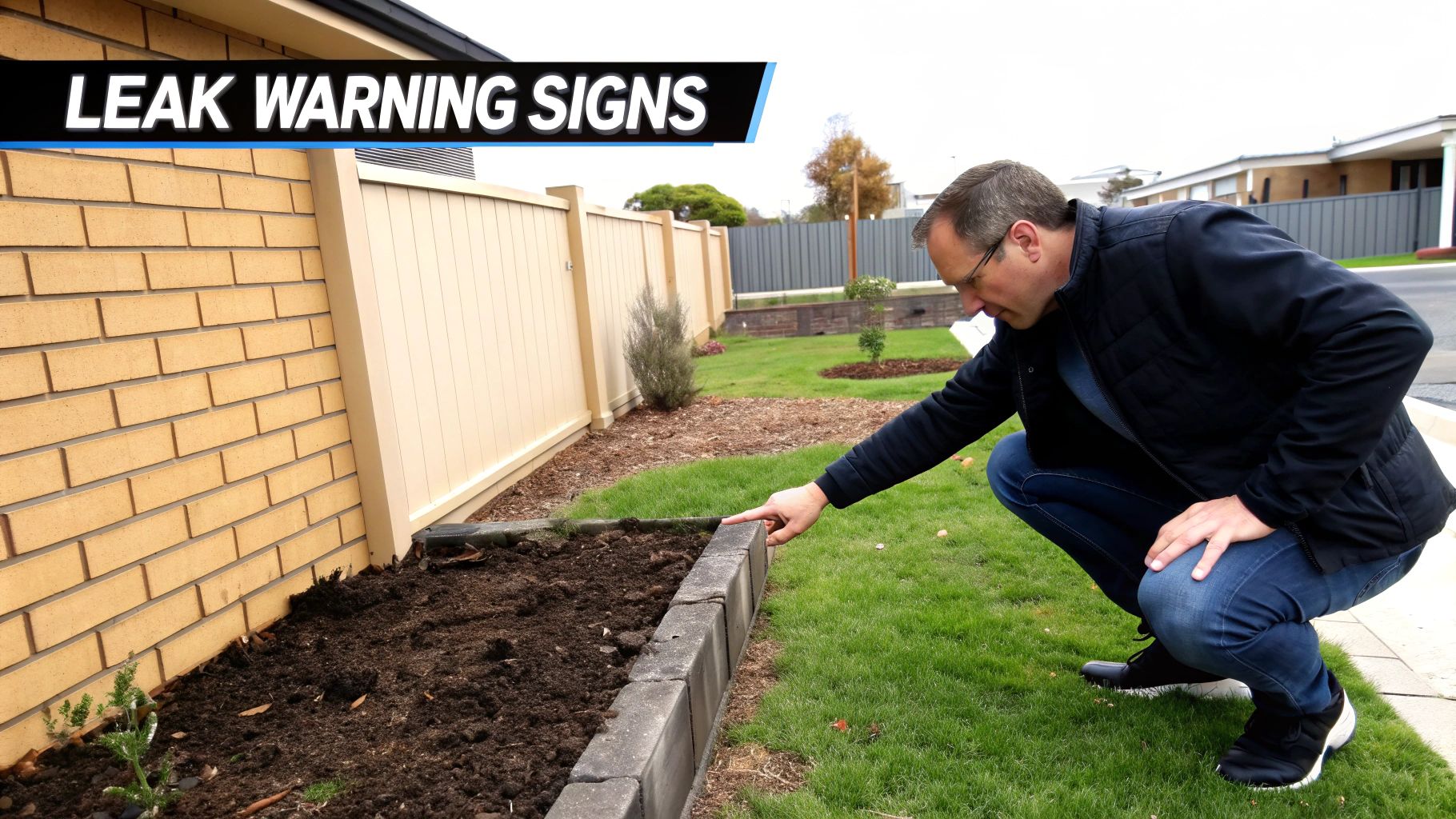
Before you can even think about fixing a leak, you’ve got to know you have one. Underground leaks are sneaky. They’re masters of disguise, often showing themselves through small, subtle clues that are all too easy to brush off. The key is to start thinking like a detective on your own property, learning to spot the signs both inside and outside your home. If you're looking to "find a plumber near me", it's likely you've already noticed a few signs.
For many homeowners here in Melbourne, the first hint isn’t a puddle but a shock when they open their water bill. If you see a sudden, crazy spike in usage that just doesn't line up with your family’s habits, that's a massive red flag. It’s a sure sign that water is escaping somewhere you can’t see.
But the evidence rarely stops with your Yarra Valley Water statement. Sooner or later, the leak will start leaving physical traces around your property. Knowing what to look for is everything when it comes to catching it early.
Signs of a Leak Outside Your Home
Your garden and yard are often the first places to give the game away. A constant, underground supply of water will inevitably change the landscape, sometimes in pretty surprising ways.
Keep an eye out for random patches of lawn that are looking way too green and happy compared to everything else. It might look great, but it could be getting a secret, steady drink from a leaking pipe right under the grassroots. A plumber in Kew or a plumber in Hawthorn can often spot these subtle signs immediately.
You might also spot areas in your garden that are always damp or soggy, even on a hot, dry day. This is really common in lower-lying parts of the yard or near retaining walls where the water naturally pools.
Other clues to watch for outside include:
- Sinkholes or Depressions: The ground can start to sink or form dips as the leaking water slowly washes away the soil from underneath.
- Cracked Paving: All that extra moisture can make the ground shift, leading to new cracks in your driveway, footpaths, or concrete slabs.
- Visible Water Flow: In more serious cases, you might actually see water bubbling up from the ground or a constant trickle of water running down the gutter when it hasn't rained.
Signs of a Leak Inside Your Home
An underground leak can make its presence felt inside the house, too. These signs are often more alarming because they suggest water might be messing with your home’s foundation.
One of the most common indoor signs is a sudden, noticeable drop in your water pressure. If turning on the tap gives you a sad trickle instead of the usual flow, it could mean a serious amount of water is being lost before it even gets to your fixtures.
You might also hear the faint, constant sound of running water, a bit like a toilet that never stops refilling, even when every tap and appliance is switched off. This is easiest to hear at night when the house is quiet. On top of that, unexplained damp spots on carpets, mould growing along skirting boards, or new cracks in your foundation walls are all serious warnings that need immediate attention.
When a leak happens under a concrete slab foundation, often the very first sign inside is a weirdly warm spot on the floor (from a hot water line) or a faint hissing sound. Don't ignore these subtle clues; they can save you from major structural damage down the line.
To help you get a quick read on the situation, here’s a quick-reference guide to the most common warning signs.
Common Warning Signs of an Underground Leak
This table breaks down what to look for and where, helping you connect the dots.
| Location of Sign | What to Look For | Potential Severity |
|---|---|---|
| Garden/Lawn | A patch of grass that's much greener than the rest; perpetually soggy soil. | Low to Moderate |
| Driveway/Paving | New cracks appearing in concrete or asphalt; shifting or lifting pavers. | Moderate to High |
| Water Bill | A sudden, significant increase in your bill without a change in usage. | Moderate |
| Inside the Home | A noticeable drop in water pressure; the sound of running water when all taps are off. | Moderate to High |
| Foundation/Walls | New cracks in foundation walls; damp patches or mould growth on floors or walls. | High |
Recognising these signs is the first, and most important, step in figuring out how to find a water leak underground. If any of this is ringing a bell, it’s time to move on from just suspecting you have a leak to actually confirming it.
Spotted a few of the tell-tale signs of a leak? Now it's time to move from suspicion to certainty.
The next logical step is to confirm your theory with a simple but incredibly effective check: the water meter test. This is your most reliable way to prove you’re losing water somewhere on your property, and you don’t have to dig a single hole to do it.
The best part? It’s a job you can absolutely do yourself. It's a straightforward process that gives you definitive proof before you even think about picking up the phone to call for plumbers in Melbourne.
How to Do the Water Meter Test
First things first, you need to find your water meter. For most homes here in Melbourne's eastern suburbs, the meter lives at the front of the property. You’ll usually find it near the street boundary, tucked inside a plastic or concrete box that's set into the ground or footpath. You might need a screwdriver or a special key to pop the lid open.
Once you’re in, you'll see the meter's face, which looks a bit like the odometer in a car. It will have a series of numbers and, most importantly, a small dial or triangle that spins. This little spinner is the leak indicator.
If that indicator is moving when you know all the water inside your house is off, you’ve almost certainly got a leak on your hands. For a more detailed look at different detection methods, you can check out our comprehensive guide on how to detect water leaks.
Performing the Test for Accurate Results
To get a reliable result, you need to be a bit methodical. Just follow these steps for a clear answer.
- Shut It All Down: Make absolutely certain that no water is being used anywhere on your property. That means turning off all taps, showers, the dishwasher, the washing machine, and any garden irrigation systems.
- Take a Starting Reading: Jot down all the numbers on your meter. Better yet, just take a clear photo of it with your phone. Pay close attention to the exact position of the numbers and that all-important leak indicator.
- Wait it Out: This is the most crucial part. Don’t use any water for a set period. For a quick check, 30 minutes is a good start. But if you suspect a slow, sneaky leak, waiting 1-2 hours will give you a much more definitive result.
- Check the Final Reading: After the waiting period is over, head back to the meter. If the numbers have ticked over or the leak indicator has moved—even slightly—that's a clear sign you have a leak.
Don't underestimate small movements. A tiny leak that wastes just one litre per hour adds up to over 8,700 litres a year. That's enough to put a serious dent in your water bill and cause real damage to the soil around your home's foundation.
Common Mistakes to Avoid
Getting an inaccurate reading can send you on a wild goose chase. To make sure your test is on the money, steer clear of these common slip-ups.
- Forgetting an Appliance: It's easy to forget things. An automatic ice maker, a toilet that quietly refills itself, or a sprinkler system on a timer can all use water and throw off your test. Double-check everything.
- Not Waiting Long Enough: A very slow pinhole leak might not register much movement in just a few minutes. You really have to give it enough time to be certain.
- Misreading the Meter: Those old analogue dials can be a bit tricky. Make sure you're reading them correctly and noting the right units of measurement (it’s usually in kilolitres).
If this test confirms your suspicions, your DIY detective work is done. The next step isn't to grab a shovel; it’s to call in the experts. A positive meter test tells you that you have a leak, but it doesn't tell you where. For that, you need professional diagnostic tools to pinpoint the exact location underground.
Finding the Leak Without Wrecking Your Yard
So, you’ve done the water meter test and confirmed it: there’s definitely a leak somewhere. Give yourself a pat on the back for some solid detective work. But now for the tricky part—finding its exact hiding spot without turning your beautiful Kew or Hawthorn garden into an archaeological dig. A skilled plumber in Camberwell or a plumber in Bulleen has the right tools for this.
This is where guesswork gets expensive, fast. Randomly digging is a surefire way to waste time, money, and your sanity. That’s why we bring in the big guns: specialised, non-invasive tech that lets us pinpoint the source of the leak with surgical precision. No mess, no unnecessary destruction.
This flowchart breaks down the basic logic for confirming you've got a problem before you pick up the phone.
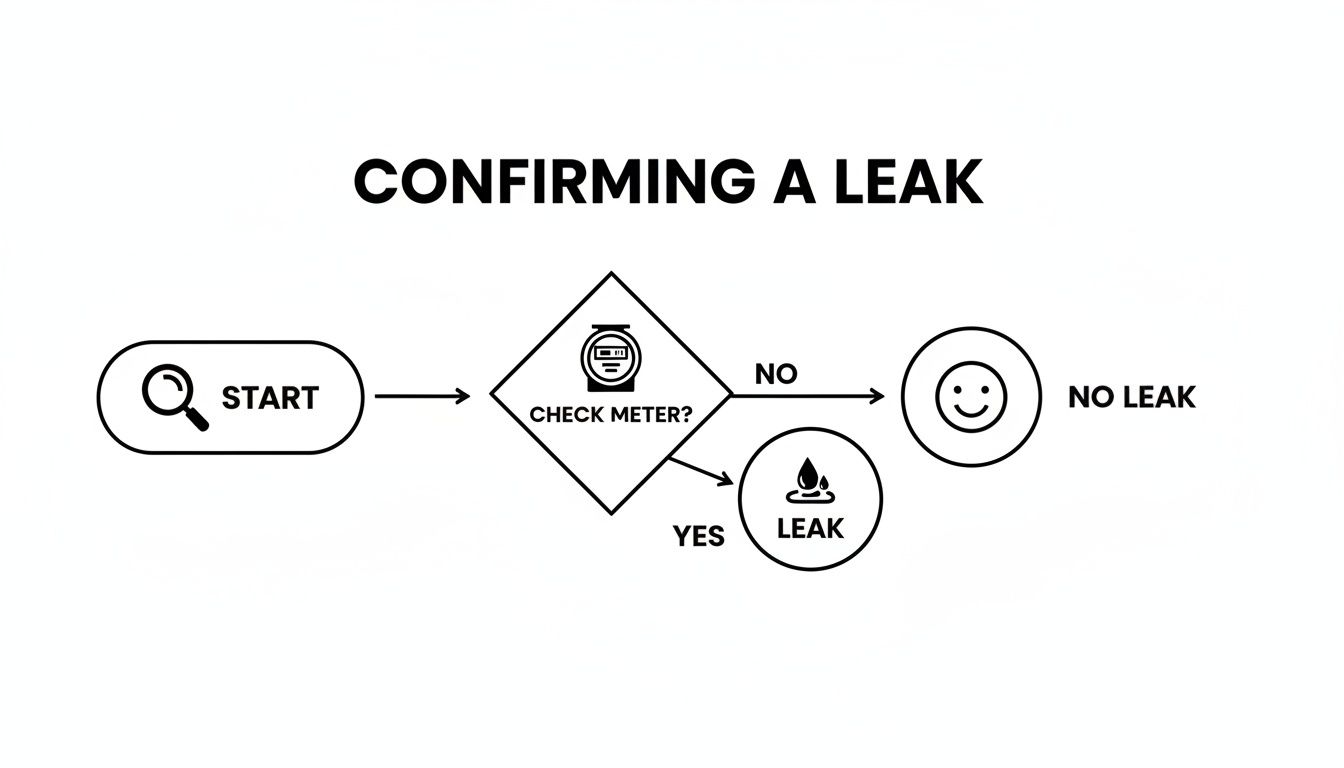
It’s a simple but powerful check. If the meter is spinning when everything inside is turned off, you know it’s time to call in the experts.
Acoustic Listening Devices
One of the most trusted tools in our kit is the acoustic listening device. Think of it as a super-powered stethoscope for your pipes. This incredibly sensitive gear allows our technicians to listen for the tell-tale sounds of water escaping from a pressurised pipe deep underground.
Every leak has a unique sound—a hiss, a whoosh, or a gurgle. This sound travels along the pipe, and by using ground microphones at different points like valves and hydrants, our experts can track the noise to its loudest point. It’s an amazingly accurate way to find leaks in main water lines buried under your lawn or driveway.
It's a bit like trying to find your phone when it’s ringing in a quiet house. You follow the sound until you're right on top of it. We do the same thing, just with advanced tech that can hear a tiny pinhole leak through metres of soil.
Thermal Imaging Cameras
When a leak is suspected closer to your home or under the concrete slab, thermal imaging cameras are our go-to. These cameras don't actually see water; they see temperature differences. Leaking water changes the temperature of the ground or concrete above it.
The camera translates these temperature variations into a colour-coded map. A mysterious cool spot on a warm day could be a cold water leak, while a warm patch on your floorboards might signal a problem with a hot water pipe beneath the slab. It’s like having X-ray vision, letting us map out the problem without drilling a single hole.
Ground Penetrating Radar (GPR)
For the really tough cases, we bring out the Ground Penetrating Radar (GPR). This is next-level stuff. GPR sends radar pulses into the ground, which bounce off different materials and objects below the surface to create a detailed map of what’s going on down there.
This technology can spot broken pipes, disturbed soil, and hidden pools of water that are otherwise invisible. The scale of this problem is huge in Australia; underground water leaks cost utility providers an eye-watering $840 million a year in lost water. One real-world test showed a controlled leak released about 4,750 litres in just 11 days—a leak only detectable with this kind of tech. Another case study, much like the urban challenges we see in Melbourne, used GPR to find a one-metre cavity created by a leaky pipe, preventing a potential road collapse.
These advanced tools are why professional leak detection is so effective. By investing in this technology, we make sure our water leak detection in Melbourne is quick, accurate, and as undisruptive as possible, paving the way for efficient, long-lasting repairs.
How We Get Your Underground Leak Sorted
Once our gear has zeroed in on the exact spot of the leak, it’s time to get it fixed—and fast. Our whole approach is built around sorting out the problem with the least amount of fuss and disruption to your home and garden. We’re not just there to patch up a pipe; we’re there to deliver a complete, stress-free fix that gets things back to normal.
Before a single shovel hits the dirt, we’ll give you a clear, upfront fixed price for the entire job. You’ll know exactly what it costs before we start. No dodgy hourly rates, no nasty surprises. It’s how we operate for every homeowner, from a plumber in Balwyn North right through to Bulleen.
Modern Fixes That Don't Involve a Bulldozer
Back in the day, fixing an underground pipe meant one thing: digging. A lot of digging. While sometimes a major break leaves no other choice, turning your prize-winning garden or new driveway into a trench is always our last resort. We’d much rather use modern, smarter methods that save you a heap of time, money, and mess.
One of the best tools in our toolkit is pipe relining. Honestly, this technology is a game-changer for fixing damaged stormwater and sewer pipes without tearing everything up. It's a perfect solution for those tricky jobs where pipes run under paths, driveways, or established garden beds. This is a key service for any specialist offering pipe relining in Melbourne.
Here's a quick look at how we tackle repairs:
- Surgical Digs: If we absolutely have to dig, we treat it like surgery. We only excavate the smallest, most precise area needed to get to the damaged pipe. This keeps the impact on your property to an absolute minimum.
- Pipe Relining: For pipes that are good candidates, we feed a tough, resin-soaked liner into the broken pipe. This liner is then expanded and cured solid, creating a brand new, super-strong pipe inside the old one.
Pipe relining isn't just a patch-up job; it's a full-blown structural repair. The new inner pipe is corrosion-proof, stops tree roots in their tracks, and can add another 50 years to the life of your plumbing.
The Pipe Relining Advantage for Melbourne Homes
For a lot of homeowners, especially in suburbs like Doncaster with lovely, established gardens, the benefits of relining are a no-brainer. You can read more about our specialist pipe relining services in Melbourne, but the main perks are simple: it saves your garden, protects your driveway, and helps you sidestep the huge costs and headaches that come with major excavation work. Our expertise in commercial plumbing also benefits from these modern techniques.
Our Promise, From Start to Finish
Our job isn't done when the water stops leaking. We're serious about leaving your property as tidy as we found it. We do a thorough clean-up of our work area, so you’re not left with a mess to deal with.
And because underground leaks don't keep business hours, neither do we. Our team is on call 24/7 for emergency plumbing services across Melbourne's eastern suburbs.
Leaky pipes are a massive problem right across the country. Aussie councils are losing a staggering $840 million in revenue from network water leakage. In one controlled test, a single leak wasted 4,750 litres in just 11 days—that’s a huge amount of water that our advanced GPR gear can find in hours. By finding and fixing these leaks quickly, we're doing our part to save a precious resource. You can find more info about the role of GPR in preventing underground pipe failures on southeastscanning.com.au.
If you’ve got a confirmed leak and you're feeling the stress, don't let it get any worse. Contact us today for a quick, accurate diagnosis and a fixed-price quote to get it sorted properly.
Your Questions About Underground Leaks, Answered
It's completely normal to have questions when you're dealing with something as stressful as a hidden leak. You want to make sure you're doing the right thing for your home. We get it. Here are a few of the most common questions we hear from homeowners across Melbourne.
How Much Does It Cost to Find and Fix an Underground Leak in Melbourne?
This is usually the first thing people ask, and the honest answer is: it depends. The final bill really comes down to where the leak is, how tricky it is to get to, and what kind of tech we need to use to find it without digging up your whole yard. Services like gasfitting in Melbourne have similar variables.
At Amari Plumbing, we're all about being upfront. We give you a fixed price for the initial leak detection service, so you know exactly what that part will cost before we start. Once we've found the culprit, we'll provide another detailed, fixed-price quote for the repair. Whether it’s a simple patch-up or a more involved job like our sewer relining service, there are no hidden surprises.
Can I Claim the Repair of an Underground Water Leak on My Home Insurance?
This one is a real "check your policy" situation. Most home insurance policies will cover the damage caused by the leak—think wrecked floorboards or issues with your foundation—but often, they won't cover the cost of fixing the faulty pipe itself.
Your best bet is to call your insurer directly and ask them to walk you through your coverage. We can supply a comprehensive report of our findings and the required work, which is a massive help when you're putting in a claim.
How Long Does Pipe Relining Last?
Pipe relining isn't a band-aid fix; it's a permanent solution. Think of it as creating a brand-new, super-tough pipe inside your old, damaged one. This new lining is seamless, stands up to corrosion and pesky tree roots, and is engineered to last for up to 50 years.
It’s the perfect option for those tricky pipes running under established gardens, driveways, or buildings in suburbs like Balwyn or Doncaster. In those spots, digging is the last thing you want to do. We'll always use a camera inspection first to make sure relining is the right and most cost-effective move for you.
Why Is My Water Bill Suddenly So High If I Can't See a Leak?
A massive, out-of-the-blue water bill is the number one red flag for a hidden underground leak. You'd be amazed how much water even a tiny, slow drip can waste over a billing cycle—thousands of litres you're paying for but not using.
The water meter test we walked through earlier is the best way to confirm your suspicions. If that test shows water is being lost somewhere on your property, it's a clear sign you need a professional. Getting it located and fixed quickly is the only way to stop the waste and avoid an even bigger shock on your next bill.
Don't let a hidden leak damage your property and your bank account. If you think you've got an underground water leak, get in touch with the experts at Amari Plumbing and Gasfitting today for a fast, accurate diagnosis and a fixed-price quote. Our team is on call 24/7 to help.