

That sinking feeling when you get a massive water bill out of the blue, or hear a faint dripping sound you just can't place—it’s a tell-tale sign something’s up with your plumbing. But before you start tearing up floorboards, there's a simple, rock-solid test you can do yourself to confirm your suspicions. When you need a plumber in Melbourne, it's best to act fast.
Your First Moves When You Suspect a Water Leak
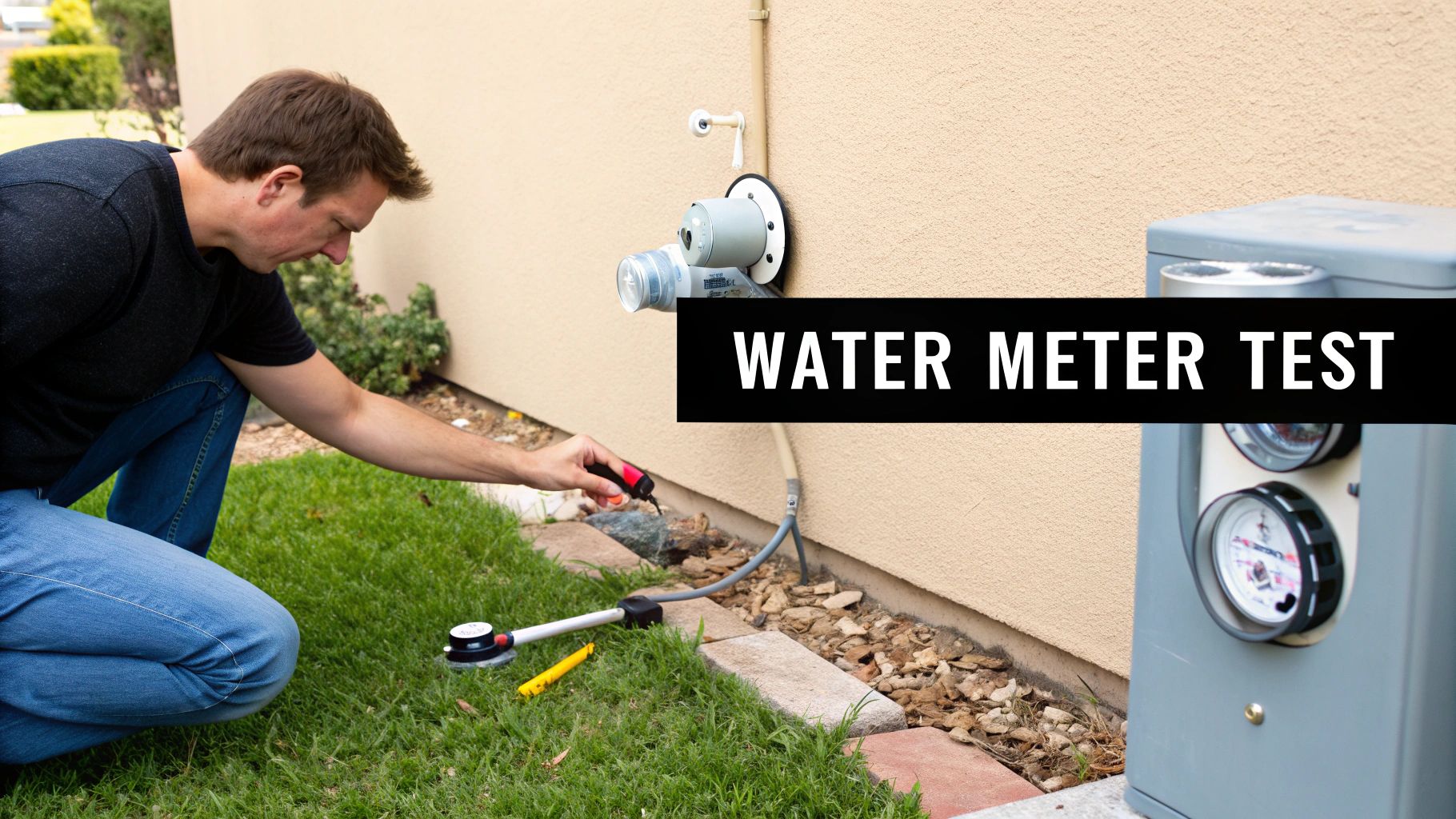
The moment you think you might have a leak, the key is to be methodical, not to panic. The best first step for any Melbourne homeowner is what we plumbers call the water meter test. It's the most reliable DIY method out there and tells you in no uncertain terms if you've got water escaping somewhere it shouldn't be. Whether you're in Balwyn or need a plumber in Doncaster, this test is your starting point.
The idea is simple: you want to see if your water meter is ticking over when you know for a fact that everything in the house is turned off.
Performing the Water Meter Test
First things first, do a full sweep of your house and make sure every single tap is tightly off. Don't forget the washing machine, dishwasher, garden hoses, and any irrigation systems. Everything needs to be off.
Now, head outside and find your water meter. It's usually near the front boundary of your property, under a small metal or plastic lid.
Pop the lid and take a clear photo of the dial, or just jot down all the numbers. Make sure you get a good look at the smallest dials or the last digit on the right—these are the most sensitive and will catch even the tiniest of leaks. Then, set a timer and wait for at least an hour. Don't use any water during this time!
Key Takeaway: After an hour, check the meter again. If that reading has moved at all—even by the smallest amount—you've got a leak somewhere. This test is your definitive proof.
Beyond the Meter: Initial Clues to Listen For
While you’re waiting for the meter test to run its course, put your ears to work. Take a slow walk through your home and listen. Pay close attention around toilets, under the kitchen and bathroom sinks, and especially near your hot water system. You're listening for any faint hissing, dripping, or humming sounds from potential blocked drains.
Toilets are a classic culprit for silent leaks, where water constantly trickles from the cistern into the bowl. You often can't even hear it. Another dead giveaway is a sudden, unexplained drop in your home's water pressure, which could point to a more serious leak in the main supply line.
Sometimes a leak is impossible to miss, like when you're dealing with visibly burst water pipes. But more often than not, it’s the sneaky, hidden ones that do the real damage over time.
Before you get too deep, run through this quick checklist. It can help you narrow things down fast.
Quick Leak Detection Checklist
Run through this simple checklist the moment you suspect a water leak in your home.
| Check | Action Required | What It Indicates |
|---|---|---|
| Water Meter | Perform the 1-hour meter test with all water off. | If the dial moves, you have a confirmed leak somewhere on your property. |
| Toilets | Add a few drops of food colouring to the cistern. Don't flush. Wait 15-20 mins. | If colour appears in the bowl, the flapper valve is leaking. |
| Taps & Fixtures | Check under all sinks for moisture or drips. Listen for hissing. | Visible water or sounds point to a leak at the fixture or its supply line. |
| Hot Water System | Inspect the unit and its pressure relief valve for any drips or pooling water. | A leak here could be from the tank or a faulty valve, wasting heated water. |
| Water Bill | Compare your latest bill to previous ones from the same time of year. | A sudden, unexplained spike is a classic sign of a hidden leak. |
Completing these checks gives you valuable information. You'll either pinpoint the problem yourself or have a much clearer picture to share with a professional plumber if you need to make that call.
Uncovering the Sneaky Signs of Hidden Water Damage
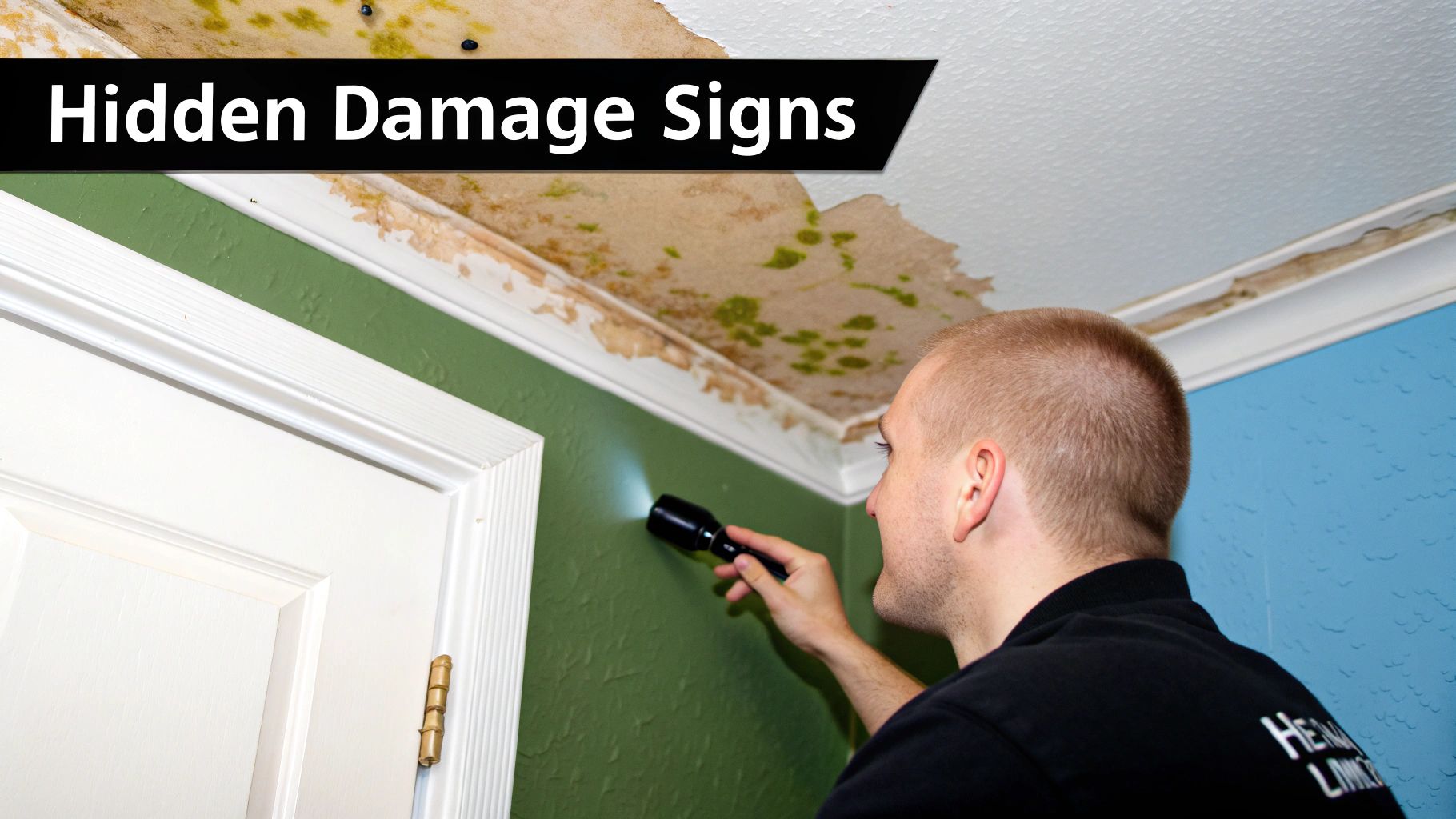
It’s rarely the dramatic gush of water that causes the most trouble. The real culprits are the slow, sneaky drips hiding behind your walls or creeping under the floorboards. They can cause havoc for weeks or even months before you have any idea they’re there.
This is where you need to put on your detective hat and learn to spot the subtle clues your home is giving you.
Forget looking for obvious puddles. One of the biggest red flags is a persistent, musty smell you just can't seem to get rid of. That damp, earthy odour is often the first sign of hidden moisture, especially in poorly ventilated spots like the laundry or under the kitchen sink.
If you notice that smell, it usually means moisture has been around long enough for mould and mildew to set in. It’s a dead giveaway that you need to start investigating.
Look for Visual Clues on Walls and Ceilings
Your walls and ceilings are fantastic storytellers when it comes to hidden leaks. Keep a sharp eye out for any changes.
- Discolouration and Stains: Those classic brownish or yellow marks on a ceiling almost always point to a leak from the bathroom upstairs or a problem with the roof. Even if they feel dry, don't ignore them—the leak might just be intermittent. A reliable roof plumber Melbourne can assess this.
- Peeling or Bubbling Paint: When drywall gets wet, it pushes the paint right off the surface. You'll see it bubble, blister, or start peeling away. This is a sure-fire sign moisture is trapped behind it.
- Warped Wallpaper: Just like paint, wallpaper will start to lift and peel when the wall it’s stuck to gets damp.
In many of Melbourne’s older homes, particularly in suburbs like a plumber Kew or a plumber Camberwell might service, these visual cues are critical. The old-school plaster walls can soak up a lot of moisture before these tell-tale signs of distress finally appear.
Check Your Floors and Skirting Boards
Water always finds its way down, so your floors and skirting boards are often the last stop for a hidden leak. Damage in these areas can signal a problem with a nearby appliance, a bathroom fixture, or even a pipe inside the wall.
Look for floorboards that are warped, cupped, or stained. If you have laminate or vinyl, you might notice it lifting or feeling a bit spongy when you walk on it. Dark, swollen skirting boards are another classic giveaway that moisture is wicking up from the floor.
A constantly damp cabinet under the kitchen sink isn't just condensation—it’s a clear warning of a slow plumbing failure. Catching these signs early is the key to preventing a minor issue from becoming a structural nightmare and a costly repair job.
Listen for a Phantom Flush
Sometimes the best leak detection tool you have is your own ears. Toilets are notorious for wasting water, and you might occasionally hear yours refilling its cistern for no reason. We call this a "phantom flush."
It happens when the flapper valve inside the cistern isn’t sealing properly, letting water silently trickle into the bowl around the clock. It might not seem like much, but this can waste hundreds of litres of water every single day. If that sounds familiar, our guide on what to do about running toilets has some specific steps you can take.
Spotting these subtle signs is your best defence. It turns you from a passive homeowner into a proactive one, ready to catch a problem before it gets out of hand. If these clues point to a leak you can't find or fix, that's your cue to call in an expert.
Advanced DIY Techniques Before Calling a Plumber
So, the water meter test confirms you've got a leak, but a visual sweep of the house reveals nothing. Frustrating, right? Before you pick up the phone, there are a couple of clever techniques you can try yourself to get a better handle on where the problem might be hiding.
These tricks bridge the gap between a simple look-around and calling in the big guns. Whether you're in a newer build in Doncaster or an older classic in Kew, gathering this extra intel is incredibly useful. If you can point a plumber in the right direction, it saves them time and you money.
Using a Moisture Meter for Certainty
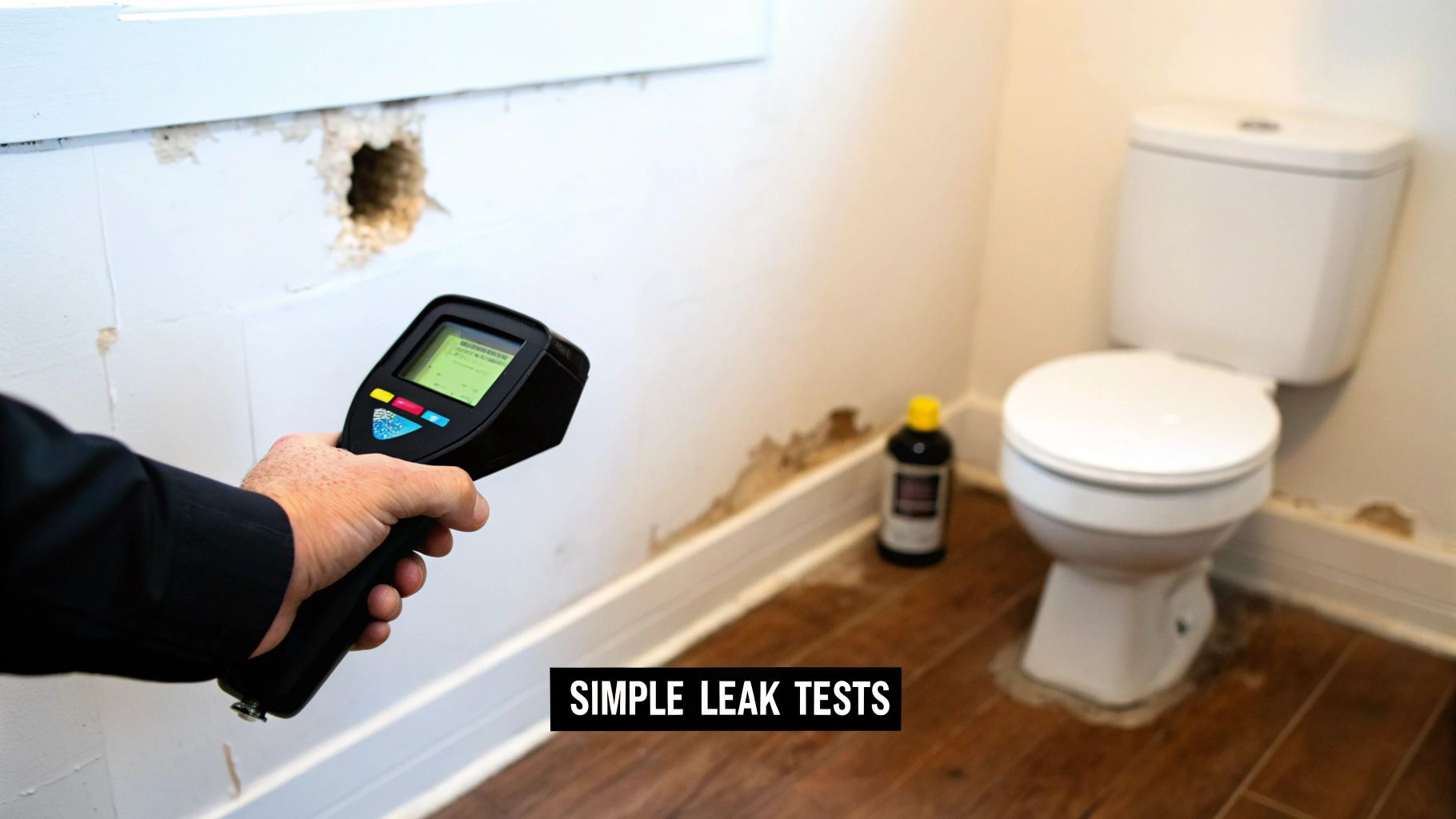
This is one of the best tools you can have in your DIY arsenal. A moisture meter is a small, relatively cheap handheld device that takes all the guesswork out of a suspicious-looking patch on the wall.
You just press its prongs against the surface you're worried about, and it gives you a precise reading of the moisture level inside.
- Get a Baseline: First, test a bone-dry section of the same wall. This tells you what "normal" looks like for that material.
- Test the Spot: Now, press the meter against the discoloured or musty-smelling area. A much higher reading is your proof—there’s definitely water trapped in there.
- Map It Out: You can even use the meter to trace the edges of the dampness, giving you a clearer picture of the leak's size and spread.
Having this data is gold. It turns a vague hunch into a hard fact, giving both you and your plumber a solid starting point for the investigation. It's often issues found this way that lead to solutions like pipe relining in Melbourne for those hard-to-reach pipes.
The Food Colouring Test for Toilets
A constantly running toilet is a massive water-waster, but the leak can be completely silent. This is where the food colouring test comes in—it’s a brilliantly simple way to see if your toilet’s flapper valve is doing its job.
Just lift the lid off the toilet cistern and pop a few drops of dark food colouring into the tank water. The crucial part: do not flush.
Now, walk away for about 15-20 minutes. When you come back, take a look inside the toilet bowl. If you see even a faint trace of colour in the bowl, you've found your leak. It means the flapper isn't sealing properly, and your toilet is quietly trickling hundreds of litres of water down the drain every day.
This five-minute check can instantly diagnose a problem that’s secretly bloating your water bill. It’s a tiny bit of effort that could save you hundreds of dollars a year.
It's worth noting that leak detection isn't what it used to be. The Australian market is set to grow from USD 183.57 million to USD 341.47 million by 2033, all thanks to incredible tech like acoustic sensors and thermal imaging that leave old-school methods in the dust. Plumbers can now find leaks without tearing your house apart. You can read more about the growth of Australia's leak detection market and its technologies.
If you’ve tried these steps and confirmed a leak you can’t see or get to, that’s your cue to call in an expert. The evidence you've gathered puts you in the best possible position for a quick, effective repair. If you've found a problem and need a professional eye, don't hesitate to contact us for advice.
Where to Look: The Usual Suspects for Household Leaks
Leaks love to play hide-and-seek, but after years of plumbing work across Melbourne, from a plumber Balwyn to a plumber Hawthorn, we’ve learned they aren’t very creative. They almost always show up in the same predictable spots.
Knowing where these weak points are turns a frustrating treasure hunt into a targeted inspection. Think of it as a room-by-room tour of the most common culprits.
The Bathroom Battleground
Without a doubt, the bathroom is ground zero for household leaks. With so many pipes, seals, and fixtures crammed into one space, it's a minefield of potential problems.
- Toilets: The wax seal at the base of your toilet is a classic failure point. If you see water pooling around the bottom, smell something musty, or the floor feels a bit spongy, that seal is your prime suspect.
- Showers and Baths: Take a close look at the silicone seals and grout. Even tiny cracks let water seep behind tiles, quietly causing rot in your walls and subfloor. A dripping shower head or a leaky tap connection is another slow-motion disaster waiting to happen.
- Vanity Units: Those little flexible hoses tucked away under the sink are under constant pressure. Any sign of a drip, rust, or crusty mineral buildup on the fittings is a warning shot that a failure is coming.
Kitchen Leak Culprits
The kitchen is another high-traffic area for your plumbing, with several appliances that are notorious for springing a leak. The worst part is they often go unnoticed, hidden away inside cabinets. A service like a dishwasher install should always be done by a professional.
Take the dishwasher. Its water inlet and drain hoses can get brittle and crack over time, or simply vibrate loose. Same goes for your fridge's ice maker—the thin plastic water line behind it is famous for splitting.
And don't forget the sink itself. The basket strainer seal can fail, and the connections for an insinkerator are another common trouble spot. If the cabinet under your sink feels damp, it's a massive red flag. We often get called out for leaking taps where the issue is actually the pipework underneath, which has been slowly dripping for months.
Being proactive is everything for a homeowner, especially in older properties. Regularly checking these spots can be the difference between a simple fix and a massive water damage restoration bill.
Looking Beyond the Four Walls
Not all leaks are inside. Your outdoor plumbing can be a huge source of water loss, and these leaks are often the sneakiest until real damage is done.
Start with your garden taps. That slow drip… drip… drip from the spout or a leak from where it connects to the wall can waste a shocking amount of water over a year.
The main water line, running underground from the street meter to your house, is the other big one. Because it's buried, you won't see it leaking. You have to look for the signs.
- Soggy Patches: Got a patch of lawn that’s unusually green or mushy, especially when it hasn't rained? That’s a classic sign.
- Low Water Pressure: A sudden, mystifying drop in water pressure throughout the entire house is a major red flag.
- Visible Water: If you see water bubbling up from the ground or pooling near your water meter, you’ve got a serious leak in the main supply line.
If you spot any of these signs, it's not something to ignore. A leaking underground pipe can erode the soil and even damage your home’s foundation. This is a job that absolutely needs a professional plumber who can find and fix the line properly.
Knowing When to Call a Professional Plumber
Your DIY skills are a fantastic asset, but knowing when to hang up the toolbelt is just as important. For any homeowner, recognising the moment to stop troubleshooting and call in an expert is a critical skill. This is especially true if you're facing a problem you can't see or one that's getting worse by the minute.
If your water meter is spinning like a top but you can't find a single drop of water, that's a massive red flag. Other non-negotiable times to call include suspecting a leak under your concrete slab, seeing major water stains spreading across the ceiling, or hearing that nagging sound of running water behind a wall. When you need a plumber near me, trust me, delaying the call in these scenarios is a gamble you don't want to take.
When DIY Isn't Enough
Let's be honest, some leaks are just out of reach for a homeowner's toolkit. Any problem hidden within your home's structure needs specialised diagnostic gear to find the source without tearing your house apart. This is where a professional commercial plumbing specialist shines.
An experienced Melbourne plumber turns up with some serious tech, including:
- Acoustic Listeners: These high-tech "ears" can hear the distinct hiss of water escaping from a pressurised pipe, even if it's buried deep underground or behind a solid wall.
- Drain Cameras: We feed a tiny, high-res camera into your pipes to get a live video feed. It allows us to see the exact location and cause of a blockage or break without any guesswork.
- Thermal Imaging Cameras: These cameras are brilliant. They spot temperature differences on surfaces, revealing the cold signature of hidden moisture behind plasterboard or under your floors.
Trying to find these leaks on your own often means making an educated guess, which can lead to cutting into the wrong section of wall or floor. That just adds to the damage and the final bill. For homeowners in areas like a plumber Bulleen or a plumber Balwyn North, a quick call to an expert not only fixes the leak but also protects your home's value and your sanity.
This flowchart can help you visualise the common spots where leaks love to hide and guide your initial checks.
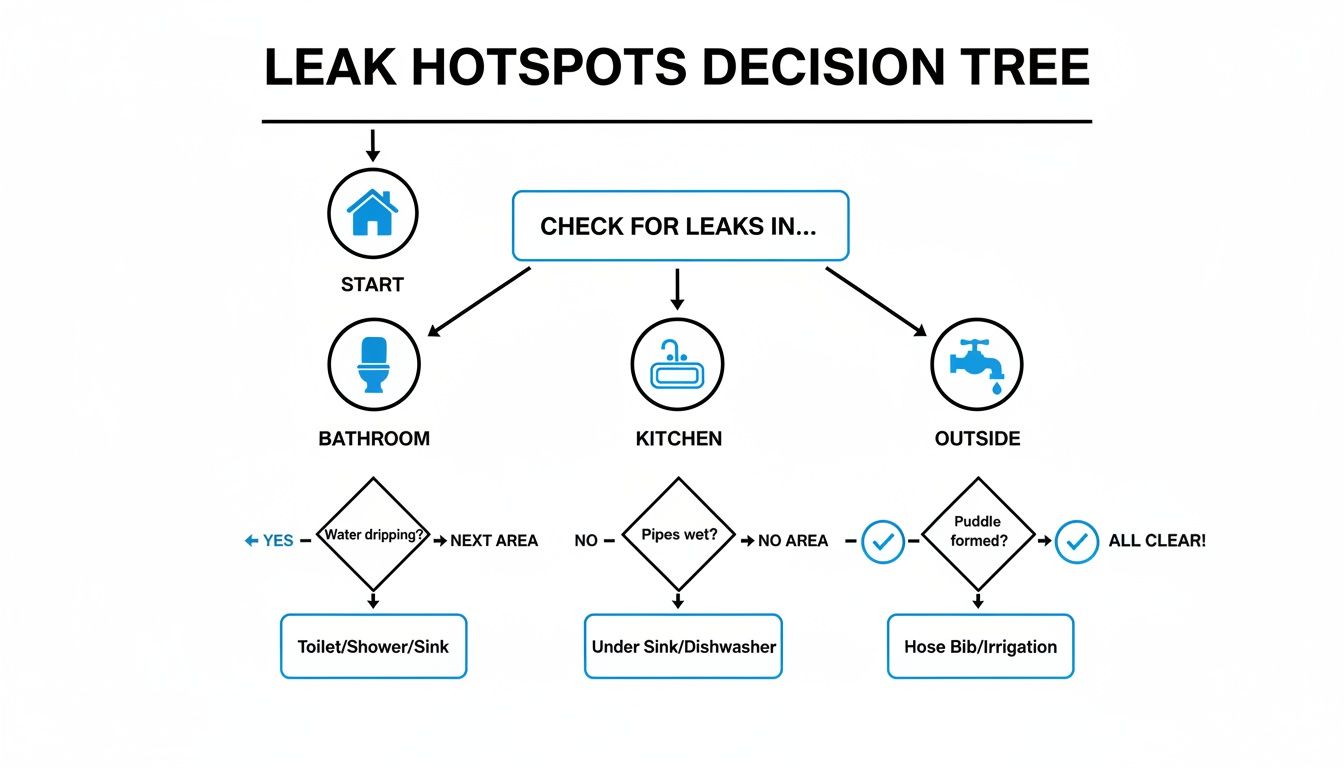
As you can see, focusing on high-risk zones like bathrooms, kitchens, and outside taps helps you methodically rule out the simple stuff before concluding the problem is a hidden one.
DIY vs Professional Leak Detection
Not sure if you should keep searching or pick up the phone? Find a plumber with this breakdown.
| Symptom | DIY Action | When to Call a Professional |
|---|---|---|
| Visible drip from a tap or under a sink | Tighten connections, replace washers. | If the drip continues after basic fixes. |
| Water pooling around an appliance | Check hoses and connections for tightness. | If you can't find the source or the leak is internal. |
| Toilet cistern constantly refilling | Use the food dye test to check the flapper. | If the problem isn't the flapper or fill valve. |
| Water meter spinning with all taps off | Conduct a meter test; check all visible fixtures. | Immediately. This signals a hidden leak you can't see. |
| Damp patches or mould on walls/ceilings | Note the location and size. | Immediately. Water is already inside your walls. |
| Sound of running water with nothing on | Try to pinpoint the location. | Immediately. This is a classic sign of a hidden pipe leak. |
| Unexplained jump in your water bill | Perform the DIY tests mentioned in this guide. | If you can't find any visible leaks after a thorough check. |
If your situation falls into that third column, don't hesitate. Getting an expert in quickly is always the smartest move.
The Cost of Waiting
Putting off a call for a serious leak can lead to catastrophic damage. A slow, hidden leak can saturate structural timber, leading to wood rot, or create the perfect damp environment for hazardous mould to thrive. What starts as a simple plumbing job can quickly spiral into a massive restoration project. This also applies to gasfitting Melbourne services, where a gas leak is an immediate emergency.
The scale of hidden water loss is staggering. In Australia, underground water leaks cost utility providers an estimated $840 million annually. To combat this, professionals now use non-invasive technologies like acoustic sensors and Ground Penetrating Radar (GPR) to find leaks with incredible precision. You can learn more from this assessment of underground water pipe leaks.
Making the Right Call
At the end of the day, your home is your biggest investment. Protecting it sometimes means recognising when a problem needs a professional solution. If you've run through all the DIY checks and are still left scratching your head, it's time to act.
A qualified plumber, particularly an emergency plumber in Melbourne, has the experience and the tech to sort the issue out efficiently, whether it’s a straightforward repair or something more complex like sewer relining. Don't let a hidden leak compromise your home's safety and integrity.
If you’ve reached the end of your DIY rope and need an expert eye, we're here to help. Contact us today for a fast, professional assessment.
Got Questions About Water Leaks? We've Got Answers.
Even with the best guide, a few questions always pop up. We get it. Here are some of the most common things Melbourne homeowners ask us about potential leaks, with straight-up answers to help you figure out what's going on and what to do next.
How Much Can a Small Leak Really Affect My Water Bill?
You’d be shocked. A single toilet with a silent leak, the kind you can’t even hear, can waste over 700 litres of water a day. It’s a staggering amount that goes straight down the drain without you ever knowing.
Even a tap that drips just once per second adds up to more than 10,000 litres over a year. These aren't just tiny drops; they’re real money leaking out of your bank account. If your water bill suddenly skyrockets for no reason, a hidden leak is the number one suspect. Running a quick water meter test is the best way to find out if you're paying for water you aren't using.
Is It Possible to Find a Leak Under a Concrete Slab Myself?
Honestly, trying to find a slab leak yourself is a bad idea. It's a job that can quickly go from bad to worse. These leaks are buried deep under your home's foundation, and finding them requires specialised gear like acoustic listeners and thermal cameras to pinpoint the source without tearing up your floors.
You might be dealing with a slab leak if you notice things like:
- Strange warm spots on the floor.
- A faint, continuous sound of running water, even when all the taps are off.
- New cracks suddenly appearing in your walls or flooring.
If any of this sounds familiar, the best thing you can do is call a professional plumber. An expert with the right leak detection tools can find the exact spot and often suggest solutions like sewer relining to fix the pipe without major excavation.
What Is the Difference Between a Water Leak and a Burst Pipe?
It really comes down to speed and volume. A leak is a slow, sneaky escape of water from a small crack or a worn-out seal. It causes gradual damage, which gives you a bit of time to investigate and get it sorted.
A burst pipe is a whole different beast. It's a sudden, catastrophic failure that dumps a massive amount of water in a short time. It's an immediate flood risk and a genuine emergency. With a leak, you can troubleshoot. With a burst pipe, your only job is to shut off the main water supply to your house and call an emergency plumber in Melbourne straight away.
Can I Ignore a Very Minor Drip?
Ignoring even a tiny drip is a mistake that will cost you. That slow, annoying drip from a tap in Balwyn or a showerhead in Doncaster isn't just wasting water; it's costing you money and putting constant strain on your plumbing fixtures. Our Melbourne plumbers see this all the time.
What starts as a minor irritation can easily wear down a component and turn into a much bigger leak down the road. It’s always cheaper and easier to get a small plumbing issue fixed now than to deal with the major headache it could become later.
If you've spotted a leak or have a gut feeling something’s not right, don't wait for the damage to get worse. The expert team at Amari Plumbing and Gasfitting has the tools and know-how to find and fix any leak, big or small. For a fast, affordable, and professional solution in Melbourne's eastern suburbs, from junction replacement to fixing hot water systems, contact us today for a free phone estimate.