

Nothing's worse than stepping into a shower expecting a lovely warm stream, only to get a blast of icy-cold water. It’s a classic Melbourne household nightmare, but the good news is that most hot water dramas are completely fixable. Getting onto it quickly with professional hot water repairs in Melbourne can get your home back to normal in no time.
This guide is here to walk you through everything, from spotting the early warning signs to knowing exactly when it's time to call in the pros for your hot water system.
Your First Stop for Melbourne Hot water repairs
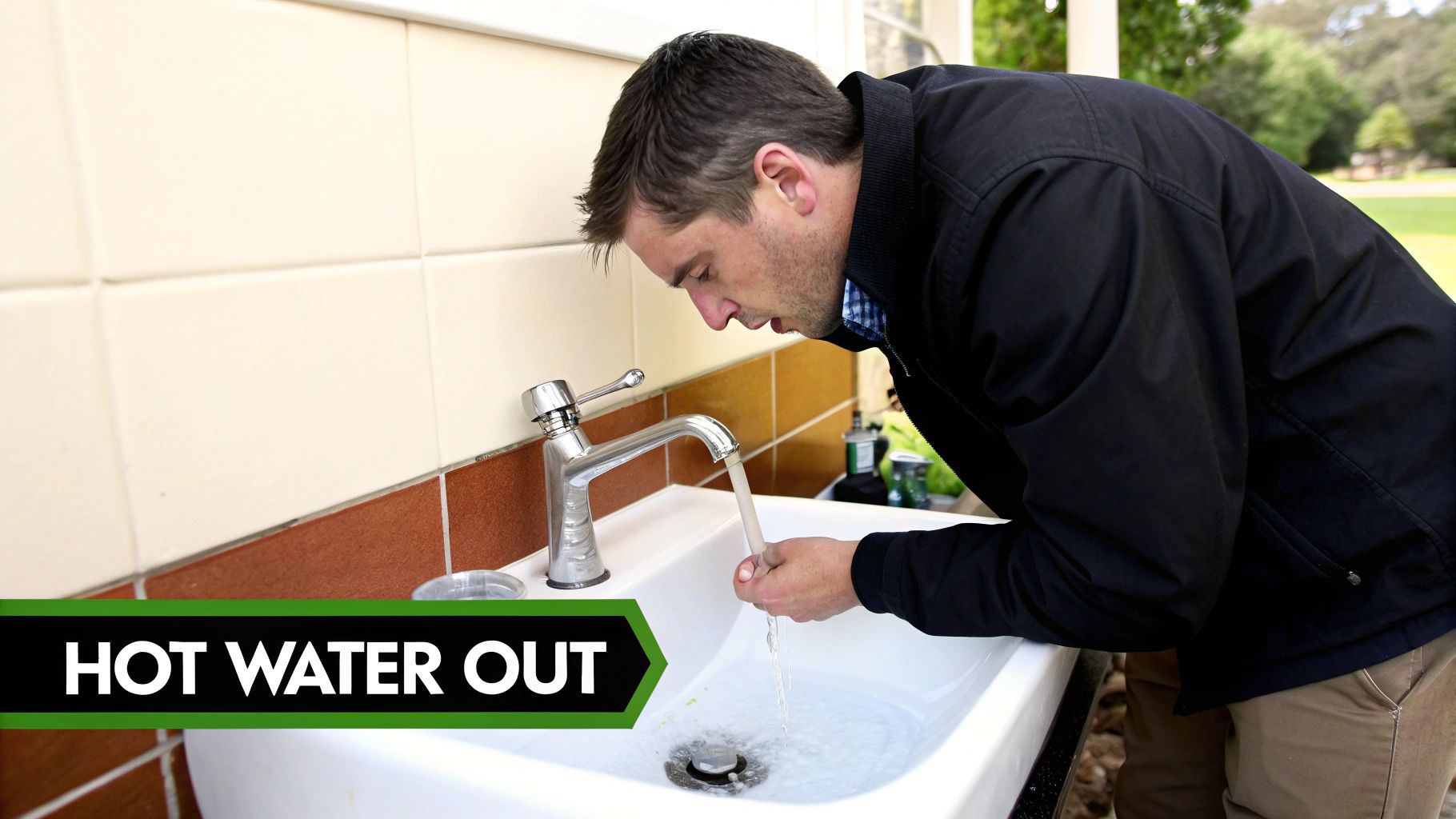
A hot water system very rarely just dies without giving you a heads-up first. It usually sends out little clues that something’s not quite right long before the taps run completely cold. Learning to read these signals is the key to stopping a small hiccup from turning into a massive, expensive emergency plumbing situation. A trusted Melbourne plumber can diagnose these issues quickly.
Think of this guide as your go-to resource for figuring out what’s going on with your system. We’ll skip the confusing technical jargon and give you clear, straight-up advice to help you work out if you’ve got a minor fix on your hands or a serious problem that needs a licensed professional, whether you need a plumber in Kew or a plumber in Hawthorn.
Common Warning Signs of a Failing System
From weird noises coming from the tank to a sudden drop in water pressure, the symptoms can be all over the place. Knowing what to look for means you can act fast and avoid the misery of a total system failure.
Here’s what to keep an eye out for:
- Inconsistent Water Temperature: Is your shower going from hot to lukewarm and back again? This often points to a dodgy thermostat or a worn-out heating element.
- Unusual Noises: Banging, popping, or rumbling sounds are usually caused by a build-up of sediment at the bottom of your tank. This gunk forces the system to work harder, making it less efficient and eventually causing damage.
- Discoloured or Smelly Water: If your hot water looks rusty or has a metallic smell, it could mean the inside of your tank is corroding. That’s a serious issue that often means you need a brand-new unit.
- Visible Leaks or Moisture: Any water pooling around the base of your hot water system is a massive red flag. Even a tiny leak can cause serious water damage if you ignore it.
To make things even easier, here’s a quick chart to help you diagnose the issue at a glance.
Quick Diagnostic Chart for Hot Water Issues
| Symptom | Potential Cause | Recommended Action |
|---|---|---|
| No hot water at all | Pilot light is out (gas), circuit breaker tripped (electric), faulty thermostat or element. | Check pilot light/breaker first. If that doesn't work, call a professional. |
| Water isn't hot enough | Thermostat set too low, faulty heating element, sediment build-up in the tank. | Check thermostat setting. If it's correct, you likely need a plumber to inspect the element or tank. |
| Rumbling/Banging Noises | Sediment and scale build-up inside the storage tank. | This requires a professional flush and service. Don't delay, as it reduces efficiency. |
| Leaking Tank or Fittings | Corrosion, pressure relief valve issue, or a crack in the tank. | Turn off the water and power/gas to the unit immediately and call for emergency repairs. |
| Discoloured/Rusty Water | Anode rod has failed, or the inside of the tank is corroding. | This is a serious sign. The unit likely needs to be replaced soon. Get a professional opinion. |
Hopefully, this table helps you quickly pinpoint what might be going wrong with your system.
A hot water system accounts for a significant portion of a household's energy consumption, often between 15% and 27% in Victoria. An inefficient or failing unit not only costs more in repairs but also inflates your ongoing energy bills until it is fixed or replaced.
At Amari Plumbing and Gasfitting, we know how urgent a hot water problem is. We're the trusted experts for hot water repairs right across Melbourne’s eastern suburbs, and we’re known for our fast response, reliable service, and affordable, upfront pricing. Whether you have leaking taps or need commercial plumbing, our team can help.
If you’re noticing any of these issues, don't wait for things to get worse. Contact us today for a fast, fixed-price quote and expert service to get your hot water running again.
What Kind of Hot Water System Is In Your Home?
Before you can even think about fixing a hot water problem, you’ve got to know what you’re working with. Homes across Melbourne have all sorts of different systems, and each one has its own quirks and common faults. Figuring out which one you have is the first step to getting it sorted out quickly and properly.
Think of it this way: you wouldn't take a diesel ute to a mechanic who only works on electric cars. It's the same for plumbing. Giving your local plumber in Melbourne, whether they're a plumber in Balwyn North or a plumber in Camberwell, the right info upfront helps them get a head start on diagnosing the issue and ensures they show up with the right parts for the job.
The Old Faithful: The Big Storage Tank System
The most common system you'll see is the classic storage tank hot water system. These are those big, cylindrical tanks you often find tucked away in a laundry, a cupboard, or standing guard outside your house.
The simplest way to think of it is as a giant kettle that’s always on. It heats a massive amount of water—anywhere from 25 to over 400 litres—and keeps it insulated and ready to go. Because it's always holding onto a large volume of water, it has a very specific set of potential problems.
Here’s what often goes wrong with storage tanks:
- Rumbling and Banging Noises: Over the years, minerals and sediment from the water settle at the bottom of the tank, forming a thick layer of sludge. This forces the heating element to work overtime to heat the water through the gunk, causing those strange, noisy protests from your tank.
- Rusty or Brown Water: Inside your tank is a clever little thing called an anode rod, which is designed to corrode so your tank doesn't. But once it's completely worn away, the tank's inner lining starts to rust. That’s when you’ll see discoloured water, a sure sign a leak isn't far away.
- Constant Dripping: The temperature and pressure relief (TPR) valve is a critical safety feature. If it starts to fail, it can drip or leak constantly. You can't ignore this one; a faulty valve needs to be looked at straight away.
The Smart and Speedy: The Instant System
Next up is the continuous flow or instantaneous hot water system. These are the small, sleek boxes you usually see mounted on an external wall. The big giveaway? They don’t store any water.
Picture this one as a high-tech espresso machine. It only fires up the moment you turn on a hot tap, heating the water as it zips through the unit. This makes them incredibly efficient, as you’re not burning energy to keep a huge tank of water hot 24/7. But their cleverness also means they have their own unique failure points. For a deeper dive on how they stack up, check out our guide on gas vs electric hot water systems.
Common headaches with continuous flow systems include:
- No Spark, No Heat: The electronic ignition is what gets the whole process started. If it fails, the gas burner won't light, and you'll be left with nothing but cold water.
- Weak Water Flow: Tiny filters on the water inlet can get clogged with debris over time. This chokes the water flow and can stop the system from activating at all.
- Gas Supply Problems: An issue with the gas valve or the supply line itself can starve the unit of the fuel it needs to do its job. This is a job for an expert in gasfitting in Melbourne.
The Eco-Warriors: Heat Pumps and Solar
Finally, we have the modern, energy-efficient champs: heat pump and solar hot water systems.
A heat pump is like a fridge working in reverse. It cleverly pulls warmth from the surrounding air and uses that energy to heat water in a storage tank. A solar system, on the other hand, uses collector panels on your roof to soak up the sun's rays and transfer that heat to your water. A specialised roof plumber in Melbourne can assist with solar system installations and roof-related plumbing.
Both of these systems are brilliant for slashing your energy bills. They can cut your water heating costs by up to 70% compared to an old electric storage tank. The trade-off is that their advanced tech can make them a bit trickier to troubleshoot.
Figuring out which one you have is usually pretty easy. A big tank means a storage system. A small box on the wall points to an instant unit. And panels on the roof? That’s solar.
Knowing this one detail is the single most important step in getting the right hot water repairs in Melbourne. When you pick up the phone, being able to say, "My gas storage tank is leaking" or "My instant system won't ignite" makes all the difference in the world. It helps us get to you faster and get your hot water back on sooner.
Repair or Replace? Making the Smart Call on Your Hot Water System
So, your hot water system is on the fritz. Now you’re facing that classic homeowner dilemma: do you patch it up and hope for the best, or is it time to bite the bullet and invest in a new one? This isn't just about getting the hot water back on; it's a big financial decision. Let's move past the guesswork and look at the hard facts that will give you a clear answer.
The first and most important thing to consider is age. Most hot water units in Melbourne are built to last around 8 to 12 years. If yours is getting on a bit or has already passed that milestone, constantly paying for repairs is a losing battle. Think of it like an old car—at some point, the endless trips to the mechanic just don't make financial sense anymore.
This flowchart can help you visualise which type of system makes the most sense for different homes and their needs.
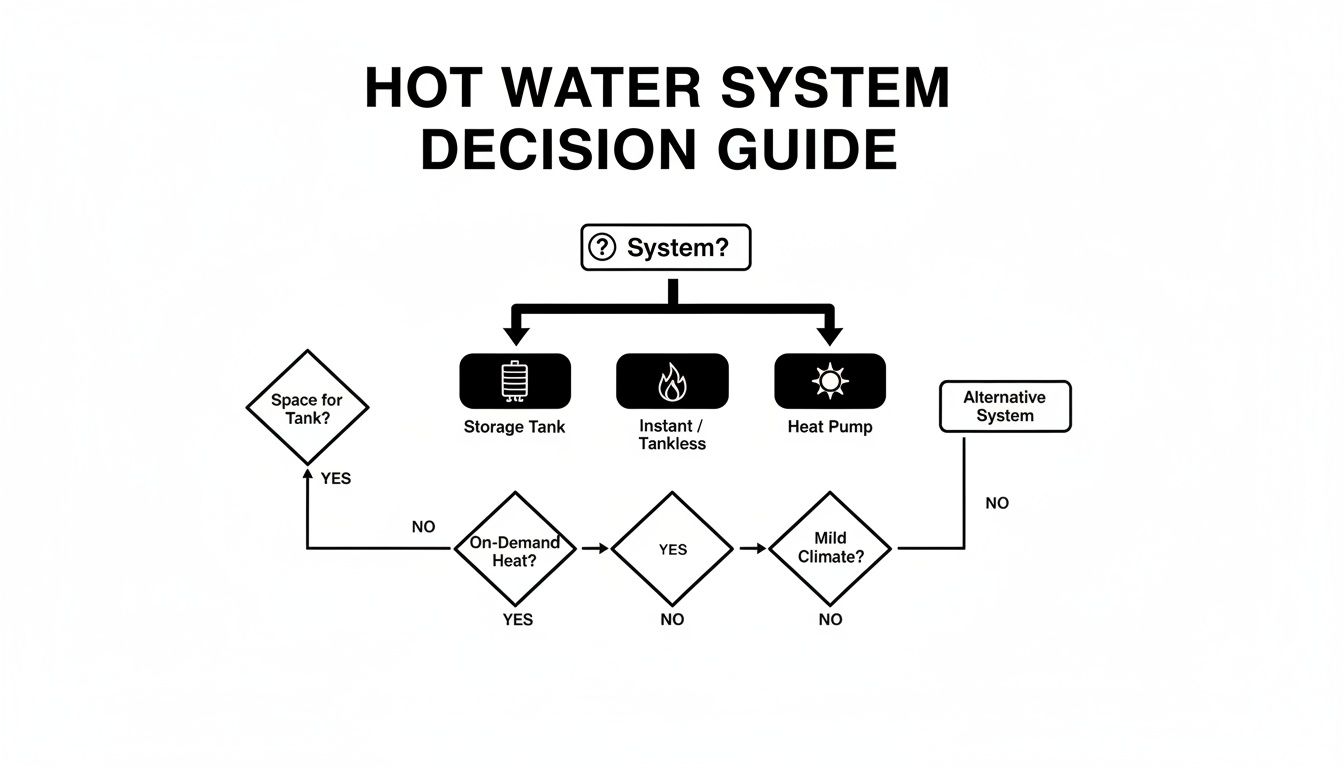
As you can see, things like available space and how much hot water you actually use play a huge role in choosing between a storage tank, an instantaneous unit, or a heat pump.
A Plumber’s Rule of Thumb: The 50% Rule
To cut through the confusion, we often use a simple guideline in the trade called the "50% Rule." It’s dead simple: if a repair quote comes in at more than half the cost of a brand-new, comparable system, it’s time to replace it.
Let's say a major fix is going to set you back $800, but a new unit is $1,500. You’re already looking at paying over half the replacement cost for what is essentially a temporary patch-up on an ageing system. In that case, putting your money towards a new unit with a full manufacturer's warranty is the much smarter long-term play. For a deeper dive, check out our guide on how long hot water systems last.
The Hidden Costs of an Old, Tired System
An old, inefficient hot water system is a quiet drain on your finances. It’s not just about the repair bills you can see; it’s about the ones you can't—like your climbing energy bills. Here in Victoria, water heating makes up a whopping 15% to 27% of a home's total energy use. An older unit has to work much harder to do its job, and that extra effort shows up directly on your quarterly power or gas bill.
This slow financial bleed is a huge part of the repair-vs-replace equation. Data from Aussie service providers shows that common repairs like a new thermostat or heating element can cost anywhere from A$150 to A$450. A leaking tank, however, is usually the final nail in the coffin, meaning a full replacement is needed, often costing A$700–A$1,200 or more. Once you’re facing multiple repairs a year, the numbers speak for themselves.
When Your Hot Water Problem Isn't the Heater at All
Sometimes, a hot water system that keeps failing isn't the real problem. It’s actually a symptom of a much bigger, hidden issue with your home’s plumbing. Things like weak water flow, fluctuating pressure, or even rusty-looking water can often be traced back to old, deteriorating pipes.
This is where you can waste a lot of money repeatedly "fixing" the heater when the pipes are the real culprit. If you’ve had a few plumbers out and no one can seem to provide a lasting fix, it might be time to look at the health of your entire plumbing network.
Persistent plumbing issues can undermine the performance of even a brand-new hot water system. Addressing underlying pipe problems first is essential for a reliable, long-term solution.
In these cases, a modern solution like pipe relining in Melbourne can be a game-changer. This technique, also known as sewer relining, repairs your pipes from the inside out, without having to dig up your garden or knock down walls. It restores proper flow and protects your investment in a new hot water system. If you suspect something deeper is going on, you need a team that sees the whole picture, not just the heater.
Let's face it, nobody likes the surprise of a hefty plumbing bill. A broken hot water system is stressful enough without the added worry of a budget blowout. That’s why we believe in being completely upfront about costs. We want to clear the air around hot water repairs and replacements in Melbourne, so you can make a smart decision for your home without any nasty surprises.
Knowing the numbers is the first step. The final price can swing quite a bit depending on what’s wrong, the parts needed, and the type of unit you have. We’ll walk you through the typical costs and even let you in on how government incentives can make a brand-new, super-efficient system a lot more affordable than you might think.
Breaking Down the Costs of Hot Water Repairs
When you get a plumber out, the final bill usually has a few moving parts. There’s often a call-out fee just for showing up. Then you’ve got the labour, which is typically charged by the hour. And finally, there’s the cost of any parts that need replacing, like a thermostat or a tempering valve.
We do things a little differently at Amari Plumbing and Gasfitting. To take the guesswork out of it, we give you a fixed-price quote upfront for every job. It doesn’t matter if you’re a plumber in Balwyn or a plumber in Doncaster, the price we quote is the price you pay—no running clocks, no hidden extras. You get total peace of mind before we even touch a tool.
Typical Price Ranges for Common Jobs
So, what can you expect? For minor repairs, like swapping out a faulty thermostat or replacing a sacrificial anode rod to protect your tank, you’re often looking at a few hundred dollars. Bigger jobs, like fixing a major leak or replacing a critical valve, will naturally cost more because they take more time and the parts are more expensive.
A full system replacement is obviously the biggest investment. For a standard hot water system in Melbourne, you can generally expect a replacement to cost somewhere between A$1,200 and A$2,500. This number is shaped by the plumber's labour rates (usually A$80 to A$120 per hour) and how tricky the installation is, which can take anywhere from two to six hours.
Our promise is simple: clear, upfront pricing. You’ll get a detailed quote outlining the full cost before we start. No sticker shock when the job is done—guaranteed.
How Government Rebates Can Slash Your Costs
This is one of the best-kept secrets for Melbourne homeowners. You can chop a huge amount off the price of a new hot water system thanks to government programs. The Victorian Energy Upgrades (VEU) program is specifically designed to help households like yours switch to more energy-efficient models.
By upgrading to a modern heat pump or solar hot water system, you could be eligible for some serious rebates. These incentives can knock hundreds, sometimes even thousands, of dollars off the upfront cost. It means that a top-of-the-line, energy-saving unit could end up costing you far less than you imagined. Our team can walk you through what you might be eligible for. To get the full picture, check out our detailed guide on hot water system installation costs.
To make things even clearer, here’s a quick breakdown of what you might expect to pay for different services and where those handy rebates come into play.
Estimated Hot Water Repair and Replacement Costs in Melbourne
| Service | Typical Cost Range (AU$) | Notes / Potential Rebates |
|---|---|---|
| Thermostat Replacement | $250 – $450 | A common fix when your water is too hot or too cold. |
| Leaking Valve Repair | $300 – $600 | Fixes leaks from the temperature and pressure relief (TPR) valve. |
| Anode Rod Replacement | $200 – $400 | Crucial maintenance to stop your tank from rusting out. |
| Electric Storage System Replacement | $1,200 – $2,500 | Your standard cost for swapping out an old electric unit for a new one. |
| Gas Storage System Replacement | $1,400 – $2,800 | Includes essential gasfitting compliance and safety checks. |
| Heat Pump System Installation | $3,500 – $6,000+ | A bigger investment upfront, but eligible for big VEU rebates. |
| Solar Hot Water System Installation | $4,000 – $7,000+ | Highest initial cost, but delivers the biggest long-term energy savings. |
Facing a hot water headache and worried about the cost? Don’t stress. We’re happy to provide a free, no-obligation quote right over the phone. Give us a call for an honest chat and a fixed price you can count on.
Why Professional Repairs Beat a DIY Approach
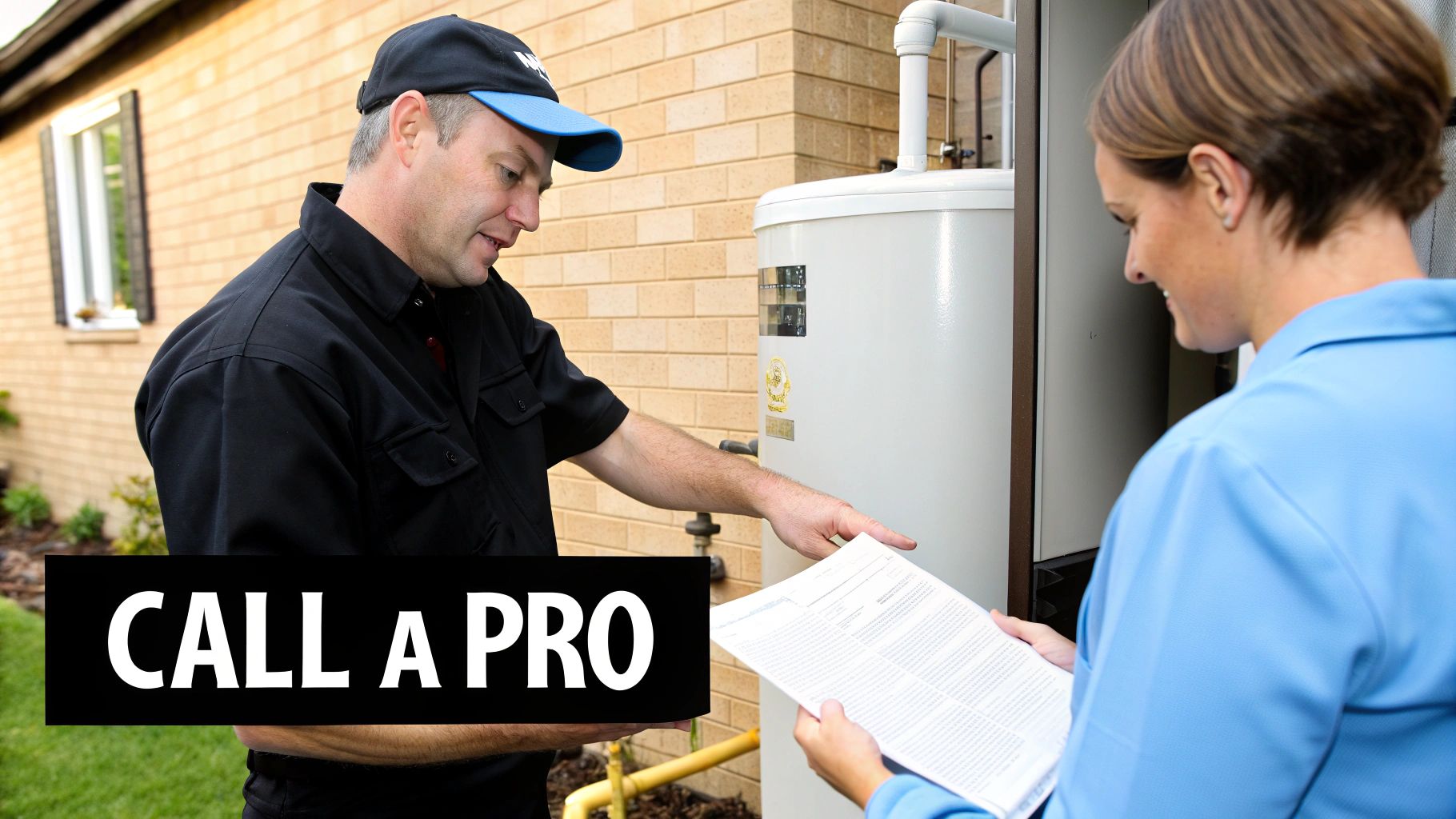
In an age of endless YouTube tutorials, it’s tempting to think you can tackle a hot water system problem yourself. But this is one job where grabbing the tools and giving it a go isn't just risky—it's downright dangerous. Calling a professional for hot water repairs in Melbourne is non-negotiable, and for good reason. If you find a plumber you can trust, you ensure your safety.
Hot water systems are a complex mix of high-pressure water, electricity, and sometimes gas. One wrong move can have some pretty catastrophic consequences. The most obvious risk is getting scalded by super-hot water, but the real dangers run much, much deeper.
The Hidden Dangers of a DIY Fix
Trying to fix things without proper training can lead to serious problems that go way beyond just not solving the initial issue. Even something that looks simple can go wrong in a heartbeat.
- Flooding and Water Damage: Fit a valve or pipe incorrectly, and you could be looking at a slow leak or a sudden flood. That means thousands of dollars in damage to your home’s floors, structure, and furniture.
- Gas Leaks: With gas hot water systems, the stakes are even higher. A dodgy connection can cause a gas leak, creating a massive fire or explosion hazard. This is strictly a job for a licensed gasfitter, no exceptions.
- Electrical Hazards: Electric systems pack a serious punch with high-voltage wiring. A wrong connection poses a severe risk of electrocution or could start a fire inside your walls.
Frankly, these aren't risks worth taking just to save a few dollars. The potential for expensive, life-threatening mistakes completely outweighs any savings you might think you're making.
The Importance of a Compliance Certificate
In Australia, any major plumbing, gasfitting, or electrical work legally requires a compliance certificate. This is the official document from a licensed professional that guarantees the job meets strict national safety standards.
A compliance certificate is more than just a piece of paper. It's your proof that the work is safe, compliant, and won't void your home insurance policy if an accident or fire occurs.
Without that certificate, you could be held liable for any damages, and your insurer might refuse to cover the claim. When you hire a qualified expert from a reputable company like Amari Plumbing and Gasfitting, you get the assurance that every job is done safely and to code.
The Professional Guarantee
Hiring a licensed and insured professional, whether you need a plumber in Bulleen or any of Melbourne's eastern suburbs, gives you peace of mind that a YouTube video just can't match. A pro plumber has the right tools, years of hands-on experience diagnosing tricky issues, and access to quality parts.
They can pinpoint the root cause of a problem—not just patch up the symptom—which means you get a lasting fix. On top of that, all our work is backed by a full guarantee, so you’re protected if anything comes up after the repair. Don’t gamble with your family's safety or your home's integrity. For safe, compliant, and guaranteed hot water repairs Melbourne residents can trust, contact us today.
Your Local Hot Water Experts in Melbourne's East
When your hot water dies, the last thing you want is to wait around. You need someone local, someone who gets how disruptive it is, and someone who can get there fast. For homeowners right across Melbourne's eastern suburbs, Amari Plumbing and Gasfitting is that go-to team for fast, no-fuss hot water repairs in Melbourne.
While we're wizards with hot water systems, our expertise doesn't stop there. We handle the full spectrum of plumbing headaches. From dishwasher installation and junction replacement to emergency services, we are the Melbourne plumbers you can rely on.
Our roots are firmly planted in the local community, which means we're committed to providing prompt, professional service. Whether you’ve got an emergency burst pipe, a tricky gasfitting job, or stubborn blocked drains, our team is kitted out and ready to sort it out.
What Makes Amari Stand Out?
Look, we know you’ve got options when it comes to choosing a plumber. That’s why we’ve built our reputation on a few simple promises that we know actually matter to you.
- Rapid Emergency Response: We treat urgent jobs with the urgency they deserve. As your local emergency plumbers in Melbourne, our goal is to get to you quickly to minimise the damage and get your home back to normal.
- Transparent Fixed Pricing: No guesswork here. We’ll give you a clear, fixed-price quote over the phone. What we say is what you pay—no nasty surprises.
- Guaranteed Workmanship: We take pride in our work and stand behind it. All our repairs and installations come with a solid guarantee, so you can have complete peace of mind.
- Clean Site Promise: We respect your home. Our plumbers make sure to leave your property just as clean and tidy as they found it.
When you're in a pinch, getting in touch with us is dead simple.
This screenshot shows you exactly how straightforward it is to reach out for a quick quote.
Basically, you can either pop your details into the form for a quote or just call us directly for an immediate response if it's an emergency.
Operating from our base in Doncaster, we cover a wide range of suburbs. We provide expert plumbing services and are the trusted local plumbers for residents in Balwyn and Doncaster. When you're searching for a "plumber near me" who is genuinely part of your community, our team is ready to help.
Don’t let a busted hot water system ruin your day. For fast, reliable service from a team that cares, contact us now for an upfront, fixed-price quote.
Your Hot Water Repair Questions, Answered
When the hot water cuts out, the questions start flooding in. We get it. To help you feel a bit more in control of the situation, here are the straight answers to the questions we hear most often from Melbourne homeowners.
Repair or Replace? How Do I Make the Call?
This is the big one, and it often comes down to simple maths. A good rule of thumb is to look at the age of your system. If your hot water unit is pushing past the 10-12 year mark and you've had to call a plumber out a few times recently, a full replacement is probably the smarter financial move.
While only a licensed plumber can give you the final verdict, think about it this way: if a single repair quote is getting close to 50% of the cost of a brand new unit, it's a pretty clear sign that you're better off investing in a new, reliable system for the long haul.
Can I Just Fix a Small Leak Myself?
As tempting as it might be to have a crack at it yourself, we strongly advise against DIY hot water repairs. You're dealing with a seriously dangerous mix of high-pressure water, electricity, and sometimes gas. One wrong move could lead to severe burns, major flooding, electrical shocks, or even a gas leak.
For your own safety, and to make sure you don’t void your home insurance, any hot water repairs Melbourne residents need should always be left to a licensed and insured professional. It's just not worth the risk.
How Long Will a Hot Water Repair Take?
This really depends on what's gone wrong. A straightforward job, like swapping out a busted thermostat or replacing a sacrificial anode, can often be sorted in an hour or two. We'll be in and out before you know it.
More serious problems, like tracing an electrical fault or fixing a major leak, will naturally take a bit longer. At Amari Plumbing and Gasfitting, our goal is always to pinpoint the issue fast and get the job done right, often on the very same day, so you can get back to your normal routine with minimal fuss.
What’s the First Thing I Should Do in a Hot Water Emergency?
If you've discovered a massive leak and water is going everywhere, you need to act fast to prevent serious damage.
- Shut off the water: Find the main water valve for your house (usually out the front) or the smaller isolation valve on the pipe leading into your hot water tank. Turn it off completely.
- Kill the power or gas: For an electric system, flick the switch at your fuse box. For a gas unit, turn the control knob on the system itself to the 'OFF' position.
- Call an emergency plumber: Get on the phone with a 24/7 service that can get to you quickly.
Don't ever wait and see in an emergency. A burst hot water tank can dump hundreds of litres of water through your home, causing huge, expensive damage to floors, walls, and furniture.
For fast, reliable, and expert advice on any hot water drama, you can trust the local team at Amari Plumbing and Gasfitting. Contact us today for a clear, fixed-price quote and let's get your hot water sorted for good.