

That sneaky suspicion you have an underground water leak can be a real worry. Often, the first clues are subtle – a patch of lawn that’s just a bit too green, a corner of the yard that’s always a bit squishy, or a water bill that suddenly skyrockets. A qualified plumber in Melbourne can help diagnose these issues.
Before you start digging up your garden, you need to know what you’re looking for. Your property will often give you little hints long before a small leak becomes a major disaster. Learning to read these signs is your best defence against costly water bills and serious damage to your Melbourne home.
Spotting the Visual Giveaways
The most obvious signs are often right there at your feet. That patch of lawn in your Balwyn garden looking unusually lush and vibrant? It's probably not your gardening prowess. More likely, a pipe underneath is giving it a constant, unwanted drink. This is a common issue for a plumber Balwyn to encounter.
But it’s not just about a green patch. Keep your eyes peeled for other visual clues:
- Soggy Spots: Look for areas in your yard that are always damp or spongy, even when it hasn’t rained for days.
- Puddles & Sinkholes: In areas like Kew with lots of established trees, you might notice random puddles forming. Worse, you could see small sinkholes appear as leaking water slowly washes away the soil underground. A plumber Kew can investigate the cause.
- Pavement Cracks: Noticed new cracks snaking across your driveway or garden path? This can happen when the saturated ground underneath starts to shift and settle.
- Uneven Pavers: If your landscaping pavers or bricks have suddenly become a trip hazard, it’s a red flag that the ground beneath them is waterlogged and unstable.
- Foundation Issues: A leak close to your house can be serious. Look for moisture seeping into your sub-floor or even fine cracks appearing in your home's foundation.
A hidden leak does more than just waste water—it can literally undermine the ground your house stands on. What starts as a damp patch can lead to major structural problems if left unchecked. A Melbourne plumber can assess the risk.
To help you quickly identify what might be going on, here’s a quick rundown of the common symptoms you might see around your property.
Quick Guide to Underground Leak Symptoms
| Symptom | What It Looks Like | Potential Cause |
|---|---|---|
| Lush Green Patches | A section of your lawn is much greener and grows faster than the surrounding area. | A slow, steady leak from a water pipe is acting like an underground sprinkler. |
| Persistent Soggy Ground | An area of your yard feels marshy or spongy underfoot, even without rain. | Water is saturating the soil from a leaking pipe below the surface. |
| Sudden Drop in Water Pressure | Your showers feel weak, and taps aren't running with their usual force. | A significant amount of water is escaping the system before it gets to your taps. |
| Unexplained High Water Bill | Your water bill has jumped significantly without any change in your usage habits. | Water is constantly running somewhere on your property, likely from a hidden leak. |
| Cracks in Paving/Foundation | New cracks have appeared in your driveway, paths, or the foundation of your home. | The ground has become unstable and shifted due to water erosion from a leak. |
| Faint Hissing Sounds | A quiet hissing or humming noise can be heard near where your water line enters. | This is the sound of pressurised water escaping through a small crack in the pipe. |
Recognising these signs early is key. Don't just dismiss them as odd quirks of your property; they're often the first and only warning you'll get.
Listening for Trouble
Sometimes, the clues aren't visible at all. A classic sign is a sudden, annoying drop in water pressure. If your morning shower has lost its punch, it might be because water is escaping the pipe somewhere between the street and your house. It's wise to find a plumber to investigate.
You might also hear the leak. This one takes a bit of quiet concentration. Late at night, when the house is still, listen carefully near where your main water line enters the property. Can you hear a faint hissing or humming sound? That’s the tell-tale noise of pressurised water forcing its way out of a small hole or crack.
These subtle signs are often your earliest warning. If you notice any of them, it's time to investigate further or give a professional plumber in Melbourne a call to get it checked out.
Practical DIY Methods to Confirm a Leak
So, you think you've got a leak. Before you start digging up the garden, there are a few straightforward tests you can run to confirm your suspicions, and they won't cost you a cent. These are simple enough for any homeowner in Doncaster or Camberwell to tackle, giving you the hard evidence you need to figure out what's next. A local plumber Doncaster can always help if you're unsure.
The most reliable tool you have is your water meter. Think of yourself as an investigator; systematically checking your meter is the best way to prove that water is escaping somewhere on your property, unseen.
This simple infographic breaks down how to use your senses to spot those initial tell-tale signs, even before you get to the meter.

Honestly, leak detection just starts with paying attention. Using your eyes, ears, and even your sense of touch to notice small changes around your property is a crucial first step.
Master the Water Meter Test
When it comes to hidden leaks, your water meter is the ultimate truth-teller. It clocks every single litre that comes onto your property, so if that dial is spinning when everything's off, you've got a problem.
Here’s how you do it.
First up, make absolutely sure nothing is using water inside or outside your house. That means the dishwasher and washing machine are off, all taps are shut tight, and nobody is flushing the toilet. Don't forget to check the garden taps, too.
Next, find your water meter. It's usually near the front of your property in a small concrete or plastic box. You might need a screwdriver to gently pry the lid open.
Now, take a close look at the dial. Many meters have a small spinning triangle or wheel (often red or black), which is the leak indicator. If it's moving, even just a little, you've definitely got a leak. On older meters without this feature, just jot down the numbers on the dial. Wait for 30-60 minutes without using any water, then check them again. If the numbers have climbed, that's your confirmation.
This simple test is your most powerful diagnostic tool. A moving meter when all taps are off is undeniable proof of a leak. It pinpoints the problem to your side of the meter, making it your responsibility to fix.
Rule Out Common Culprits Inside the Home
Before you convince yourself the leak is buried under the lawn, it's smart to eliminate the usual suspects indoors. These common issues can easily mimic the signs of an underground leak. A constantly running toilet, for example, can waste hundreds of litres a day and keep your water meter ticking over.
The toilet dye test is a super easy way to check for this.
- Take the lid off your toilet cistern.
- Add a few drops of food colouring into the tank water.
- Don't flush! Just leave it for about 15-20 minutes.
- Now, look in the toilet bowl. See any of that colour? If you do, it means the flapper valve is faulty and letting water seep through.
This is often a simple fix that could save you a massive headache. While it might seem disconnected from a leak in your yard, ruling out these internal problems is a vital process of elimination. It stops you from searching for a problem outside when the real issue is in your bathroom.
Sometimes, what looks like a big underground problem is actually a few smaller ones combined, like a dripping tap and a slow toilet leak. These can be just as problematic as blocked drains. If you're also dealing with blockages, knowing how to clear blocked drains can give you a better picture of your home's overall plumbing health.
Inside a Professional Plumber’s Toolkit
So, your DIY tests have confirmed a leak, but you’re left staring at your lawn, wondering where on earth the water is escaping from. This is where you put down the shovel and call the pros. Taking a wild guess and starting to dig can quickly turn your garden or driveway into a muddy, expensive mess.
At Amari Plumbing, we skip the guesswork entirely. We use some seriously clever, non-invasive technology to pinpoint hidden leaks with surgical precision. It’s all about finding the problem without creating a bigger one. Our Melbourne plumbers are equipped with the latest tools.
And it's a huge problem. Across Australia, undetected leaks cost utility providers around $840 million every year. Think about that—about 10% of all water pumped into our networks is lost before it ever reaches a tap. You can read more about how non-invasive technologies are tackling this massive issue.
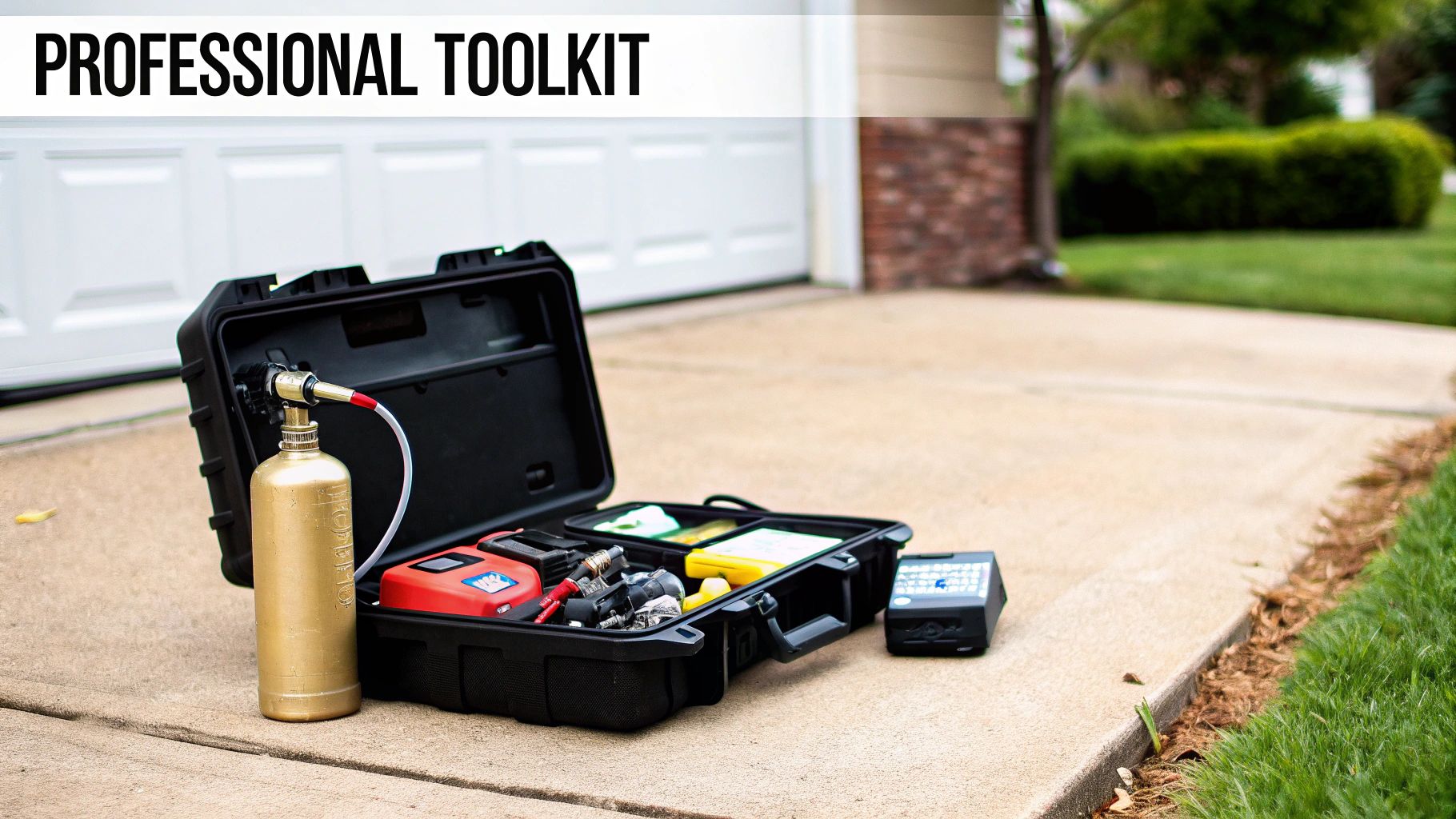
Acoustic Listening for Leaks
One of our go-to tools is an acoustic listening device. You can think of it as a super-powered stethoscope for your plumbing. When water escapes a pressurised pipe, it makes a specific sound—a hiss, a gurgle, a faint whoosh—that you’d never hear from the surface.
Our plumbers use highly sensitive ground microphones to listen for these tell-tale frequencies along the suspected pipe path. As we move the sensor, we listen for where the sound gets loudest. This lets us narrow down the leak’s location to within a metre or so, often even closer.
It’s an absolute lifesaver for homeowners in areas like Hawthorn or Camberwell, where digging up established gardens or beautiful paving is the absolute last thing anyone wants to do. For complex jobs, a specialist plumber Hawthorn is essential.
Thermal Imaging Cameras
Next up is the thermal imaging camera. This bit of kit doesn’t see water, but it sees temperature. Water escaping from a pipe is almost always a different temperature to the soil around it.
A cold water leak creates a cool patch on the ground, while a hot water leak makes a warm spot. The camera shows us these temperature differences as a heat map, lighting up anomalies that point us right to the saturated ground above the leak. It’s brilliant for finding leaks under concrete slabs or driveways without touching a thing.
Professional leak detection isn't a guessing game; it's a science. By combining different technologies, an experienced plumber builds a complete picture of what’s happening beneath the surface. This ensures the first dig is the only dig.
Tracer Gas Leak Detection
For those really sneaky leaks where other methods aren't clear, we bring out the tracer gas. This is an incredibly accurate technique. We introduce a completely safe, non-toxic gas (usually a hydrogen/nitrogen mix) into the emptied pipe. A professional service like gasfitting Melbourne is required for this.
The gas molecules are way smaller than water molecules, so they can escape through the tiniest pinhole crack. The gas rises up through the soil, and we use a sensitive "sniffer" device to detect exactly where it’s coming to the surface.
By sweeping the detector across the area, we can find the precise point the gas is escaping, which lines up perfectly with the leak below. It's the ultimate confirmation before we start any excavation.
Understanding this gear shows you why it’s a smart investment. It turns the hunt for an underground leak from a destructive gamble into a precise, efficient operation. This accuracy also opens the door to modern repairs like trenchless pipe relining in Melbourne, which can often fix the pipe without us needing to dig a massive trench.
If your water meter is spinning and you’re at a dead end, don't grab a shovel. Contact Amari Plumbing and let our team and our tech solve the mystery for you.
When High-Tech Gear is the Only Way Forward
Sometimes, a leak is just plain stubborn. It’s buried deep under a concrete driveway, lost in a maze of other utility lines, or just refuses to show itself with the usual methods. When the simple tests don't cut it, it's time to bring out the big guns.
For these really tricky situations, advanced technology is the only way to get a clear picture without tearing up your property. It lets us see what’s happening underground, completely blind.
This is especially true on larger properties, like you might find around Templestowe, where extensive gardens and complex layouts can turn leak detection into a real headache. In these scenarios, we rely on sophisticated equipment like Ground-Penetrating Radar (GPR) to solve the mystery without destructive digging. A plumber Templestowe can advise on the best approach.
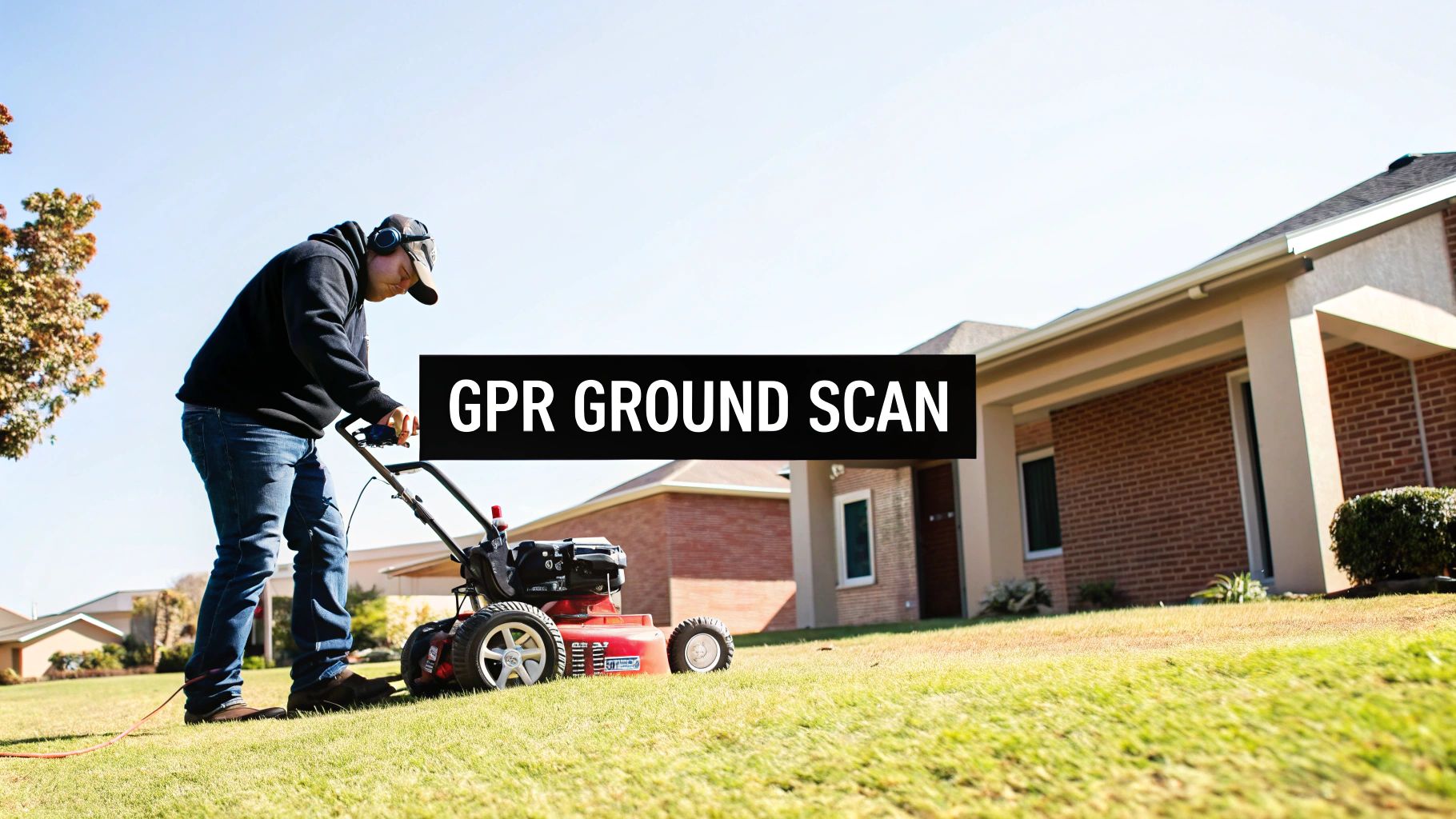
Here you can see a GPR scan in action. A technician is methodically mapping the ground, and the data collected builds a detailed image of everything hidden below—pipes, cables, and even the disturbed, water-logged soil that a leak creates.
So, What Exactly Is Ground-Penetrating Radar?
Think of GPR as a bit like an ultrasound for your yard. It’s a powerful, non-invasive tool that uses radar pulses to create a virtual map of everything beneath the surface.
As the GPR unit is wheeled across the ground, it sends high-frequency radio waves down into the soil. These waves hit different materials—pipes, rocks, air pockets, and saturated soil—and bounce back at different speeds. A receiver picks up these return signals, and a computer crunches the data to build a detailed picture of what’s going on down there. It’s how a trained technician can spot the tell-tale signs of a leak.
GPR doesn't just find the pipe; it finds the problem. It can spot the washed-out soil and underground voids caused by water erosion long before they turn into a dangerous sinkhole or damage your home's foundation.
This tech-driven approach gives us incredible accuracy for diagnosing complex issues. It's the same kind of gear used by local councils to manage ageing infrastructure and head off major failures. For instance, when acoustic methods failed to find a leak causing a road to sag in Queensland, GPR stepped in. It identified a massive cavity around a pipe caused by water erosion, allowing for a repair just before the road collapsed. It’s a game-changer.
When Is GPR the Right Tool for the Job?
While tools like acoustic listeners and thermal cameras are great for many leaks, GPR really shines in specific, challenging situations. It becomes our go-to when:
- The leak is buried under thick concrete slabs, driveways, or patios.
- The exact location of the pipe is a mystery, helping us map out lines before we even think about digging.
- There’s a tangle of different utility lines underground, and we need to tell them apart to avoid damage.
- Challenging soil conditions are making other methods unreliable.
Using GPR lets us build a precise, efficient repair strategy. This accuracy doesn’t just save you time and money; it provides real peace of mind.
Knowing exactly where the problem is allows for targeted solutions, like trenchless repairs. For many of these deep or hard-to-reach pipe problems, exploring modern pipe relining in Melbourne is a fantastic option, fixing the pipe from the inside without major excavation.
Ultimately, using high-tech gear like GPR transforms the search for an underground leak from a disruptive guessing game into a precise, scientific operation. If you're dealing with a persistent leak you just can't find, this is how we ensure we find it and fix it right the first time.
Knowing When to Call an Emergency Plumber
Trying to find a leak yourself has its limits. Knowing when to put down the tools and call in a professional is probably the most important step in protecting your property from serious damage.
Sure, checking the water meter and having a look around for obvious soggy spots are great first steps. But some situations go way beyond a simple weekend fix. Delaying the call can turn a small, manageable problem into a catastrophic and eye-wateringly expensive repair job. When you need emergency plumbers Melbourne, act fast.
Recognising that tipping point is everything. If you've run through all the DIY checks and your water meter is still spinning like a top even with everything shut off, you've confirmed you have a leak. The problem is, you still don't know where it is. That’s your cue to get a professional on the phone. Continuing the search without the right gear is usually a waste of time and just lets more water soak into your property, causing more damage by the minute.
Red Flags That Demand a Professional
Some signs are absolute non-negotiables. If you see any of these, don't hesitate—it's time to call an emergency plumber. These red flags often point to a much bigger problem that needs specialised tools and years of experience to fix safely and properly.
- Suspected Slab Leak: Have you noticed warm spots on your floor, or can you hear the faint sound of running water under the house? Maybe you've seen new cracks forming in your foundation. These are all classic signs of a leak directly under your home's concrete slab, and this is definitely not a DIY job.
- Visible But Unreachable Source: You can see clear evidence of a leak, like a patch of lawn that’s always squishy or even a sudden sinkhole, but you have no clue where the water is actually coming from. A professional can trace the pipe and pinpoint the source without having to dig up your whole garden.
- Drastic Drop in Water Pressure: A sudden, major loss of water pressure right across the house often points to a serious break in your main water line. This needs immediate attention to prevent massive water loss and stop the ground from washing away.
- Water Contamination: If your tap water is suddenly discoloured, looks rusty, or has bits of grit in it, it could mean that soil and other contaminants are getting into your pipes through a crack.
The True Cost of Waiting
It’s easy to fall into the "wait and see" trap, but with underground leaks, time is absolutely your enemy. The longer a leak is left, the worse the consequences get. What might start as a simple pipe repair can quickly spiral into a much bigger, messier project.
Delaying a professional call isn't saving you money; it's simply deferring a much larger bill. The cost of repairing foundation damage, getting rid of mould, or replacing eroded soil far outweighs the expense of getting an expert in for a timely leak detection service.
Here in Australia, advanced leak detection has completely changed how we manage urban water systems. A major project with Sydney Water, for example, analysed data from over 365,000 pipes and developed a failure prediction model with an 80% detection rate. It just goes to show how technology helps us find and fix these problems with precision.
For homeowners in Balwyn, Doncaster, and across Melbourne’s eastern suburbs, a quick response is always the most cost-effective one. The ground composition in these areas can be prone to erosion, making it even more critical to act fast. If you've spotted the signs of a serious problem, like those linked to burst water pipes, getting an expert onsite fast is essential.
If you're facing any of these urgent signs, don't wait for the problem to get worse. We have the technology and expertise to find and fix your underground water leak fast, protecting your property and giving you peace of mind.
Your Underground Leak Questions Answered
When you suspect there's a leak hidden somewhere underground, your mind probably starts racing with questions. It’s completely normal. How much is this going to set me back? What's causing it? How long until it's fixed? We get these questions all the time from homeowners across Melbourne, so let's run through them. A professional plumber near me can provide specific answers.
How Much Does Finding and Fixing a Leak Cost in Melbourne?
This is usually the number one question, and the honest answer is: it really depends. The final cost comes down to where the leak is and how tricky it is to get to.
For instance, a simple leak bubbling up in a garden bed in Balwyn North might only be a few hundred dollars to pinpoint and patch up. But if you've got a stubborn leak buried deep under your concrete driveway in Kew, that's a different story. We'd likely need more advanced gear to find it, and the fix might involve something more complex like sewer relining or pipe relining in Melbourne. Naturally, that's going to be a bigger investment.
Here at Amari Plumbing, we're all about being upfront. Once we've had a look, we’ll give you a clear, detailed quote so you know exactly what you're looking at before we start any work. No surprises.
Are Tree Roots a Common Cause of Pipe Leaks?
You bet they are. In suburbs with beautiful, established trees like Camberwell and Hawthorn, tree roots are one of the main offenders we see. It’s just nature at work—those roots are hard-wired to hunt for the moisture and nutrients inside your pipes. A plumber Camberwell will often check for this first.
They can sneak their way into the tiniest joint or a hairline crack. Once they're in, they just keep growing, eventually blocking the pipe entirely or, worse, splitting it wide open. If you've got big trees on your property, checking for root intrusion is always high on our list.
Don't underestimate the power of nature. A single thirsty tree root can compromise your entire plumbing system over time, turning a tiny crack into a major break.
Who Is Responsible for the Pipes on My Property?
Knowing who's responsible for what is key. For Melbourne homeowners, the line is usually drawn at the water meter.
- You (the Property Owner): You're on the hook for the water line running from your meter to your house, plus all the pipes inside. If the leak is anywhere on this stretch, it’s your responsibility to call a licensed plumber to sort it out. That's why the water meter test is so telling—it quickly confirms if the problem is on your side of the fence.
- Your Water Authority: Your local water authority (like Yarra Valley Water or South East Water) takes care of the water main out in the street and the pipe that runs right up to and includes your water meter.
How Quickly Can a Professional Plumber Find the Leak?
With today’s tech, it's a lot quicker than you'd probably guess. Our experienced plumbers use professional-grade acoustic listening gear and electronic sensors that can often pinpoint an underground leak's exact spot within an hour or two.
Now, if the leak is buried deep under concrete or there’s a lot of background noise, it might take a little longer to get a clear signal. But our goal is always to find the source with as little disruption to your Doncaster or Balwyn property as possible. It means we minimise the digging and can get straight to the repair.
Got a tricky underground leak on your hands? Don't wait for it to get worse. The expert team at Amari Plumbing and Gasfitting has the right tech and the local know-how to find it and fix it, fast. Contact us today for a professional assessment and a clear, upfront quote.