

That faint dripping sound you hear late at night? The water bill that suddenly jumped for no reason? These aren't just minor annoyances; they're your home’s early warning system. For homeowners all over Melbourne, a water leak that goes unnoticed can quietly cause serious structural damage, encourage unhealthy mould growth, and waste thousands of litres of precious water. Amari Plumbing and Gasfitting are your go-to experts for finding and fixing these issues quickly and affordably.
The True Cost of a Hidden Leak in Your Home
A hidden water leak is one of those silent problems that can quickly turn into a full-blown, expensive disaster. As a leading plumber in Melbourne, I've seen it countless times in homes from a plumber Kew to a plumber Balwyn – a homeowner only realises something is wrong when they spot a damp patch spreading across the ceiling or feel that tell-tale squish under the carpet. By that point, the damage is already done and has often crept far from the original source of the leak.
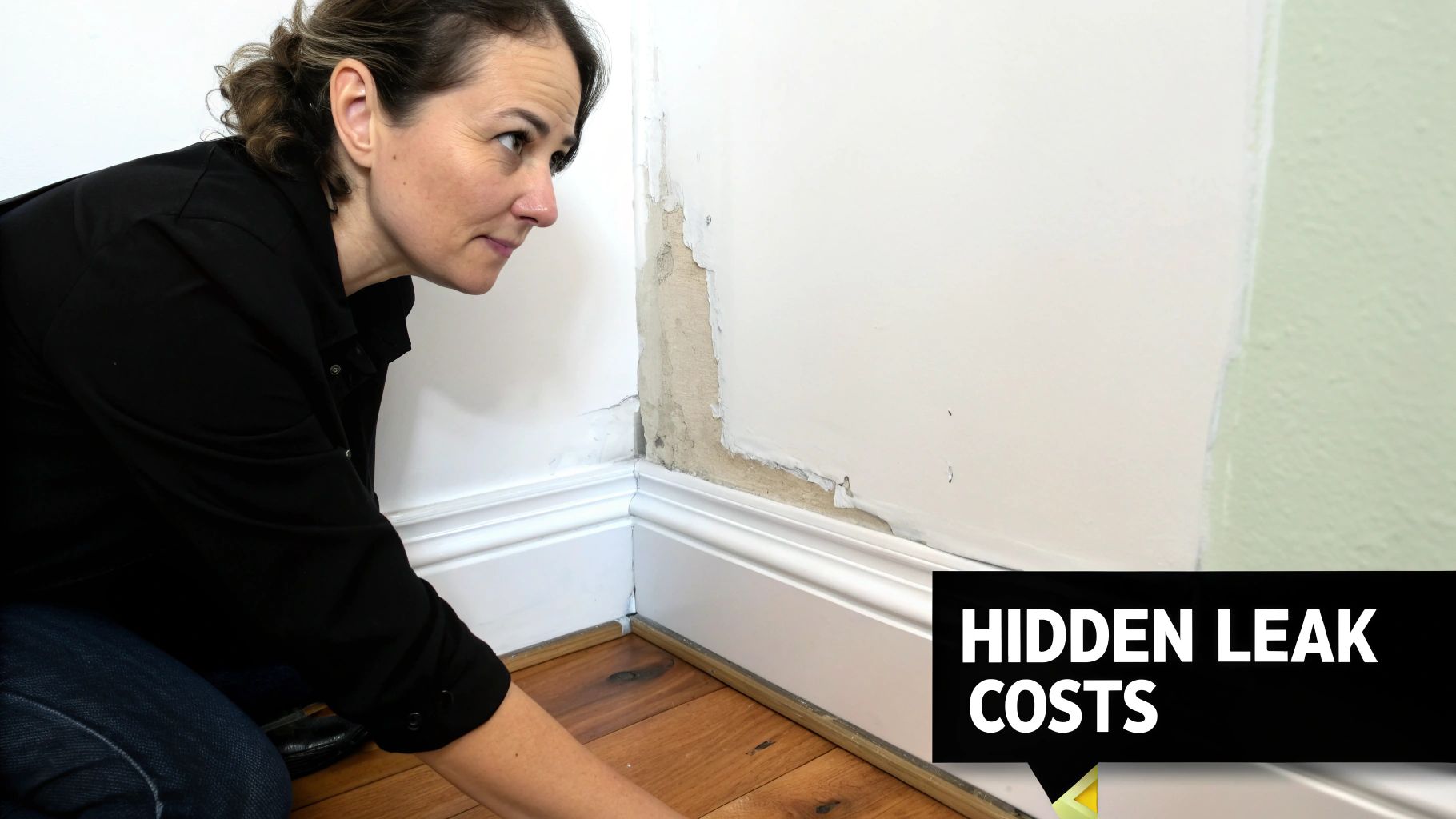
This guide is designed to help you spot the subtle clues your property gives off long before it gets to that stage. We'll get into the common culprits, from those sneaky, silent leaks under a concrete slab to the slow drips hidden away inside a wall cavity, giving you the knowledge to act fast. If you're looking for a reliable plumber near me in the eastern suburbs, our team is ready to help.
The amount of water being lost is genuinely staggering. In 2023-24, Australia's urban water networks lost an incredible 269 billion litres of drinking water to leaks and bursts. To put that in perspective, that’s enough to supply over 1.5 million households for a whole year. For homeowners in Doncaster and right across Melbourne's eastern suburbs, this highlights how a small residential leak can silently add up on your water bill while contributing to a much bigger problem. You can get more insight into this issue by checking out Australia's water network challenges on h2oglobalnews.com.
Understanding the Financial and Structural Risks
The fallout from a hidden leak goes well beyond just a higher water bill. The real costs can be much more severe.
- Structural Damage: Constant moisture is timber’s worst enemy. It can rot out structural framing, compromise concrete foundations, and seriously weaken your home's integrity over time.
- Mould and Mildew Growth: Those dark, damp spots inside your walls are the perfect breeding ground for mould. Not only is it a serious health risk, but getting rid of it properly can be an expensive, specialised job.
- Increased Utility Bills: It's not just your water bill that will climb. Your heating and cooling systems often have to work overtime to deal with the damp, humid air created by a leak, pushing up your energy costs too.
Consider this guide your first line of defence in protecting your home’s value and your family’s health. Being proactive about water leak detection is genuinely one of the smartest things you can do as a homeowner. If you even suspect there might be an issue, don't wait for the damage to show up—contact us for immediate, professional help.
Decoding the Telltale Signs of a Water Leak
Your house has its own way of telling you something’s wrong, and when it comes to plumbing, it often whispers before it shouts. The real trick to water leak detection is learning to pick up on these early warnings, well before you’re staring at a puddle on the living room floor.
Too many homeowners I’ve visited, from those with beautiful heritage places in Kew to newer builds in Balwyn, miss these signs. By the time they call, a small issue has often become a much bigger, more expensive problem. Instead of waiting for disaster, you can get on the front foot by looking for the less obvious clues that water is escaping somewhere it shouldn’t. Whether you need a plumber Camberwell or a plumber Hawthorn, our team has seen it all.
Listen to Your Walls and Floors
Sometimes, the first sign of a leak is one you hear, not see.
Wait until the house is quiet late at night. Can you hear a faint hissing, dripping, or the sound of running water coming from inside a wall? That’s a classic sign of a pressurised pipe leak that hasn't made its presence known visually… yet. A professional Melbourne plumber can use specialised equipment to pinpoint these sounds.
Another dead giveaway is a musty, earthy smell you just can’t track down. That odour is usually caused by dampness building up in hidden spots—think under floorboards or behind kitchen cabinets. It’s your nose telling you that moisture is present and mould or mildew is starting to take hold. This can also indicate blocked drains that are leaking behind the scenes.
Visual Clues Beyond Obvious Drips
Of course, the most reliable signs are the ones you can see, but you have to know what you’re looking for. Keep a sharp eye out for these changes around your home.
- Changes in Walls and Ceilings: Be on the lookout for peeling paint, wallpaper that’s starting to bubble, or discoloured patches that look yellowish or brown. Stains like these mean water is soaking into the plasterboard from the other side.
- Warped or Damaged Flooring: Have your timber floors started to warp, cup, or darken in a specific spot? Maybe your vinyl is lifting, or you’ve felt a weirdly soft, spongy section under the carpet. These are all red flags.
- An Unusually Green Patch of Grass: If one patch of your lawn is suddenly looking way healthier and greener than the rest, it might be getting some extra "fertiliser" from a leaking underground sewer or stormwater pipe. This is a common hint that you’ve got an issue with buried pipes, often needing a specialised fix like sewer relining.
A persistent musty smell is more than just an annoyance; it’s a direct signal of hidden moisture. Ignoring it allows mould to thrive and structural materials to degrade, turning a small plumbing issue into a major restoration project.
Connecting the Signs to the Source
Spotting these signs is the first part of the battle. The next is figuring out what they might mean. Our team also specialises in gasfitting Melbourne, so we can check both water and gas lines.
That damp patch on your ground-floor ceiling? It could easily be from a leaking shower directly above it. Peeling paint on a wall could be from a slow drip inside the pipework of the bathroom next door.
Once you start connecting these symptoms to potential causes, you’re in a much better position to act. Catching these things early stops them from turning into the kind of costly, disruptive repairs we see all the time. If any of this sounds a bit too familiar, it's a clear signal to investigate further. Don't put it off—get in touch and we'll help you get to the bottom of it.
Practical DIY Methods for Finding Leaks
So, you’ve got that nagging feeling there’s a leak, but you can’t see a single drop of water. Before you start worrying about what’s happening behind your walls, there are a couple of simple, detective-style tests you can run yourself. These aren't destructive, they won't cost you a cent, and they’ll give you solid proof if there’s a problem.
Think of these as your first line of defence. All it takes is a bit of time and a sharp eye.
The Water Meter Test
Your water meter is more than just a tool for the water company; it’s one of the best diagnostic tools you have. It tells you exactly when water is flowing through your pipes, and more importantly, when it shouldn't be. This is the gold-standard test for catching hidden leaks anywhere on your property.
Here's how to do it right:
- Shut everything down. Go through your house and make sure every single tap is off. Don't forget the washing machine, dishwasher, and even the ice maker in your fridge. If you have an irrigation system, turn that off too.
- Find your meter. It’s usually located at the front of your property near the street, tucked under a small plastic or metal lid. Pop the cover off to get a clear view of the meter face.
- Take a reading. Jot down all the numbers you see on the dial. A lot of meters also have a small triangle or spinning dial that moves when water is flowing. Take a quick look to see if it’s active.
- Wait it out. Now, leave everything turned off for at least an hour. Two hours is even better if you have the time.
- Check it again. Head back to the meter and compare the new numbers to your original reading.
If those numbers have ticked over, even slightly, you've got a leak somewhere. It's a dead giveaway that water is escaping somewhere between the meter and your home. For more on checking your home's plumbing health, have a look at our guide on how to test water pressure at home.
The Toilet Dye Test
Believe it or not, toilets are one of the biggest culprits for silent leaks. They can waste thousands of litres of water without making a sound. The problem is usually a worn-out flapper valve inside the cistern, which lets water constantly trickle into the bowl. This little test will expose it in minutes.
First, take the lid off your toilet cistern. Squeeze a few drops of food colouring into the tank water – just enough to give it a bit of colour.
Now for the easy part: walk away for 15-20 minutes. Just don't flush the toilet.
When you come back, peek into the toilet bowl. If you see any of that coloured water has made its way from the tank into the bowl, you've found your leak. It means the flapper valve is faulty and needs to be replaced. It's a simple fix, but one that can make a real difference to your water bill.
To help you get a head start, here’s a quick-reference table to connect the dots between what you’re seeing and where the problem might be hiding.
Common Leak Sources and Their Telltale Signs
| Symptom | Potential Source | Recommended Action |
|---|---|---|
| Musty smell or visible mould | Leaky pipe behind a wall, faulty shower seal, or poor ventilation | Check for damp patches on walls/ceilings. Improve ventilation. If persistent, professional inspection is needed. |
| Unusually high water bill | Hidden leak in the main line, a running toilet, or a dripping tap | Perform the water meter test. Check all taps and toilets. |
| Water stains on ceilings or walls | Leaking roof, plumbing in the ceiling, or faulty bathroom seals on the floor above | Investigate the room directly above the stain. Check for roof damage after rain. A roof plumber Melbourne can assist. |
| Sound of running water when nothing is on | Main water line leak or a constantly running toilet cistern | Check the toilet cistern first. If clear, the sound could indicate a more serious underground leak. |
| Damp or spongy floors | Leaking pipe under the floorboards, cracked slab, or a faulty appliance (e.g., dishwasher) | Check appliance connections. Look for warped floorboards. A slab leak requires immediate professional help. |
This table should give you a better idea of where to focus your investigation. Remember, these are just the most common culprits, and sometimes the source can be completely unexpected.
Key Takeaway: If the water meter test shows you have a leak but the toilet dye test comes back clear, the problem is almost certainly hidden in your pipes. At this point, your DIY job is done. It's time to call in a professional to pinpoint the source without tearing your home apart.
These simple checks put the power in your hands, giving you the facts you need. If you've run the tests and confirmed a leak you can't see, that's your cue to get the experts involved. Don't let a small leak turn into a big disaster.
How Professionals Pinpoint Hidden Leaks
So, you've done the DIY tests and the meter is definitely spinning, but there's not a single visible drop of water to be found. This is a classic sign of a hidden leak – the kind that’s buried under a concrete slab, tucked away inside a wall cavity, or silently seeping from a pipe deep beneath your garden. A plumber Bulleen or a plumber Balwyn North from our team is equipped to find it.
When you're dealing with a leak you can't see, guesswork is your worst enemy. This is exactly where our professional water leak detection gear comes into play. We use advanced, non-invasive equipment to find the precise source of the trouble without having to start digging up your lawn or knocking holes in your walls. It’s all about working smarter, not harder, to save you time, money, and a whole lot of stress.
Acoustic Leak Detection
One of the most reliable tools we pull out of the van is the acoustic leak detector. Think of it as a high-tech stethoscope for your plumbing. This incredibly sensitive device is designed to pick up the very specific sound frequency of water escaping from a pressurised pipe.
Our technicians use listening discs for hard surfaces like floors and walls, or ground probes for pipes running underground. By methodically moving along the suspected pipe run, we listen for the tell-tale hiss or whoosh. The noise gets louder and clearer the closer we get, allowing us to pinpoint the breach with uncanny accuracy – often down to a few centimetres.
Thermal Imaging Cameras
Another brilliant piece of kit is the thermal imaging camera. These cameras don't see moisture directly; instead, they see temperature. When water leaks from a pipe (it doesn't matter if it's hot or cold), it changes the temperature of the surrounding materials like plasterboard, timber, or concrete.
A thermal camera translates these subtle temperature differences into a colour-coded image on a screen. Cold spots show up as dark blue or purple patches, revealing the path of a hidden leak. This is a game-changer for finding those slow, seeping leaks inside walls that haven't caused a visible damp patch yet but are doing damage behind the scenes.
This flowchart shows a couple of the basic tests you can try yourself before giving us a bell.
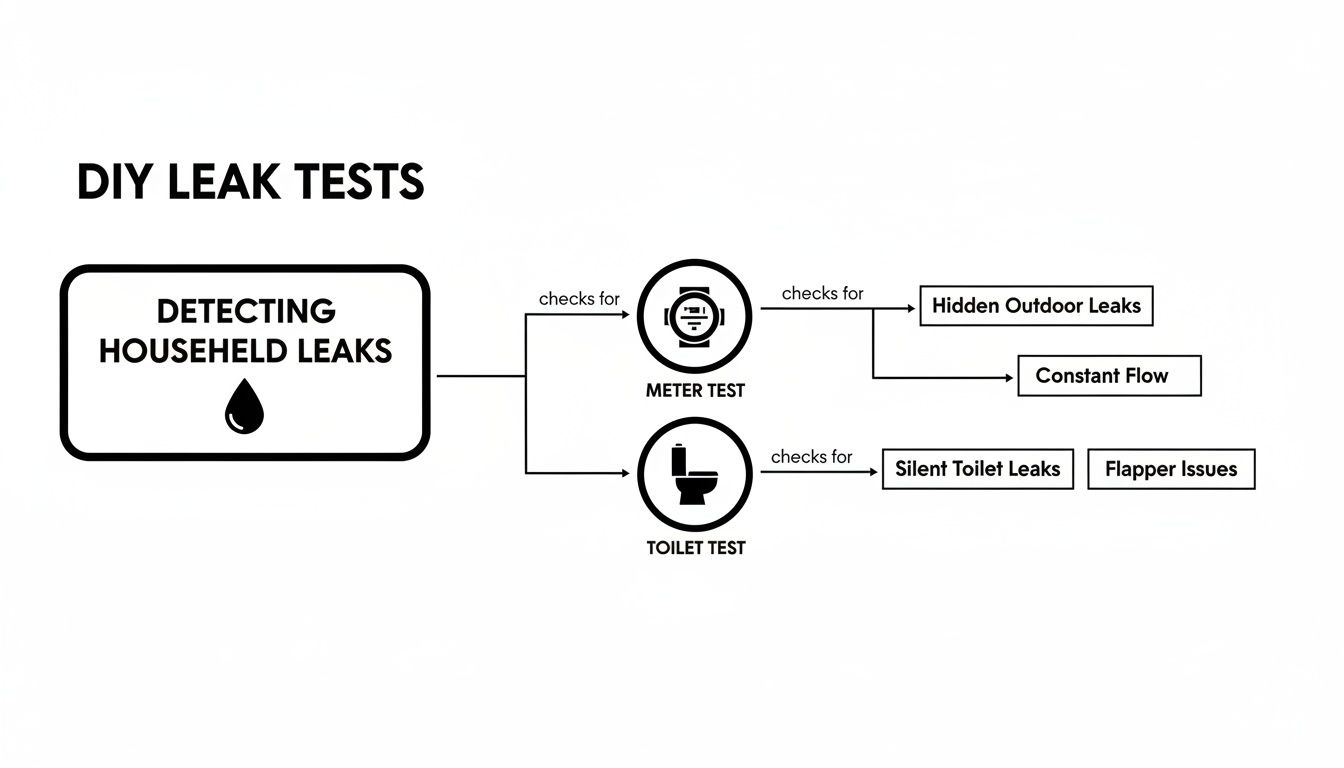
While these are great for confirming you have a leak, our professional gear is what finds its exact location without any destructive digging.
Tracer Gas Technology
For the really tricky ones – the tiny pinhole leaks or the ones that just won't show up on other equipment – we bring out the tracer gas. It’s a clever method that involves safely draining the water line in question and filling it with a completely harmless, non-toxic gas blend (usually hydrogen and nitrogen).
This gas is much lighter than air, so it escapes through even the smallest crack in the pipe and rises straight to the surface. It’ll come up right through soil, paving, or even your floorboards. Our technicians then use a highly sensitive gas ‘sniffer’ to detect exactly where the gas is surfacing, leading us directly to the problem spot.
You can learn more about these techniques in our detailed guide on how to find water leaks underground.
Knowing how we can find a problem with such precision often gives homeowners peace of mind. It’s the essential first step before we can look at modern repair options like pipe relining Melbourne, which can fix the pipe from the inside out.
If your own tests point to a hidden leak, don't just wait and hope it goes away. Get in touch with our team today and let's get it sorted.
Your Go-To Plumber for Leak Detection in Melbourne
Finding out you have a leak is stressful enough. The last thing you need is the added headache of trying to find a plumber you can trust to sort it out. For homeowners across Melbourne's eastern suburbs, from the leafy streets of Hawthorn to family homes in Doncaster, having a reliable and fast-acting plumber on your side makes all the difference.
We get it. The goal is to stop worrying about the problem and start focusing on the solution, knowing a team of pros is ready to jump in. We also offer commercial plumbing services for businesses.

When you suspect a leak, you need clear answers and you need them fast. That’s why we’re all about rapid response times and giving you a fixed, upfront price for the job. You won’t be left watching the clock, wondering what the final bill is going to look like. Our promise is simple: find the leak, fix it properly, and leave your home as clean as we found it.
Why Melbourne Homeowners Trust Amari
Choosing the right Melbourne plumbers is about more than a quick fix; it’s about peace of mind. Our team is kitted out and ready to handle any leak, big or small, 24/7.
- Prompt and Punctual Service: We know your time is precious. Our emergency plumbers Melbourne are based locally to get to the eastern suburbs quickly.
- Transparent Pricing: You’ll get a fixed price over the phone for the entire job. No hidden fees, no nasty surprises.
- Guaranteed Cleanliness: We treat your home with respect and always clean up after ourselves. It's a guarantee.
While big investments are helping reduce breaks in major water mains, the reality is that Melbourne's ageing residential pipes create their own set of challenges. South Australia, for example, saw its reported water main leaks drop to a six-year low of 3,536 in 2023. But for homeowners here, the daily risk of a dripping tap or a burst pipe is still very real.
These aren't just minor annoyances; they waste huge amounts of water and can lead to serious, costly structural damage. This is exactly where our 24/7 team shines, using precise water leak detection in Melbourne to deliver accurate, lasting repairs. You can read more about Australia's ongoing efforts to manage water infrastructure on pipeliner.com.au.
The most important thing you can do is make that first call. It connects you with an expert who can figure out what's wrong and get help on the way, stopping a small issue from turning into a full-blown disaster.
So, instead of worrying about the "what ifs," let our professionals take over. We're here to provide a fast, affordable, and tidy solution to your water leak problems.
Don’t wait for water damage to take hold. Contact us now for immediate help and a free, no-obligation quote.
Here are the answers to the most common questions we get from homeowners across Melbourne about water leaks. We want to give you the practical info you need to feel confident you're making the right call.
How Much Does Water Leak Detection Cost in Melbourne?
This is always the first question, and the honest answer is: it depends on how tricky the leak is to find.
But we hate surprises as much as you do. That's why we don't do vague hourly rates. We give you a fixed, upfront price for the whole job right over the phone. You'll know the full cost before we even step foot on your property.
Think of it this way: investing in professional detection now is always cheaper than footing the bill for major water damage repairs down the track.
My Water Bill Is High but I Can’t See a Leak. What Should I Do?
A sudden jump in your water bill is a massive red flag for a hidden leak.
Your first move? Go back and do the water meter test we walked through earlier in this guide. It’s the simplest way to get a clear answer.
If that test shows water is still running when everything’s switched off, you've almost certainly got a leak hiding somewhere. They’re often in pipes underground, inside a wall cavity, or under the concrete slab of your house. These are impossible to spot without the right gear, which is where we come in.
Can a Tiny Dripping Tap Really Waste That Much Water?
You bet it can. It’s so easy to write off a little drip as just an annoyance, but the numbers are genuinely shocking. We fix leaking taps all the time.
A single tap dripping just once a second will waste over 10,000 litres of water in a year. That adds a hefty, unnecessary cost to your water bills.
We can sort out any leaking taps with a quick, affordable, fixed-price service. It’s a small job that saves you a surprising amount of money and conserves Melbourne's water in the long run.
Will Finding the Leak Damage My Property?
Our entire process is built around being non-invasive. We don't just show up with a sledgehammer and hope for the best.
We use advanced, non-destructive tools like acoustic sensors and thermal imaging cameras to pinpoint the exact source of a leak without any guesswork. This means we don't have to dig up your garden or start cutting holes in your walls just to find the problem.
And for the repair itself, we often use modern methods like pipe relining, a 'no-dig' technique that fixes pipes from the inside. We’re committed to finding the least disruptive solution and always guarantee to leave your property as clean and tidy as we found it.
If any of these sound familiar, or if you have other questions, the expert team at Amari Plumbing and Gasfitting is ready to help. Don't let a small leak turn into a huge headache.
Contact us today for a free, no-obligation quote and get professional advice you can trust.