

Right, so you've got a blocked toilet. That sinking feeling as the water starts to rise instead of fall is something we've all felt. Before you start to panic, let's walk through what to do. The best approach always starts with the simplest, safest methods. More often than not, a plunger or a simple hot water and soap trick is all you need to sort out minor clogs from things like toilet paper or organic waste. For more stubborn issues, a plumber in Melbourne can provide a quick solution.
Remember this golden rule: Never, ever use boiling water. The sudden, intense heat can crack the porcelain bowl, turning a simple blockage into a very expensive replacement.
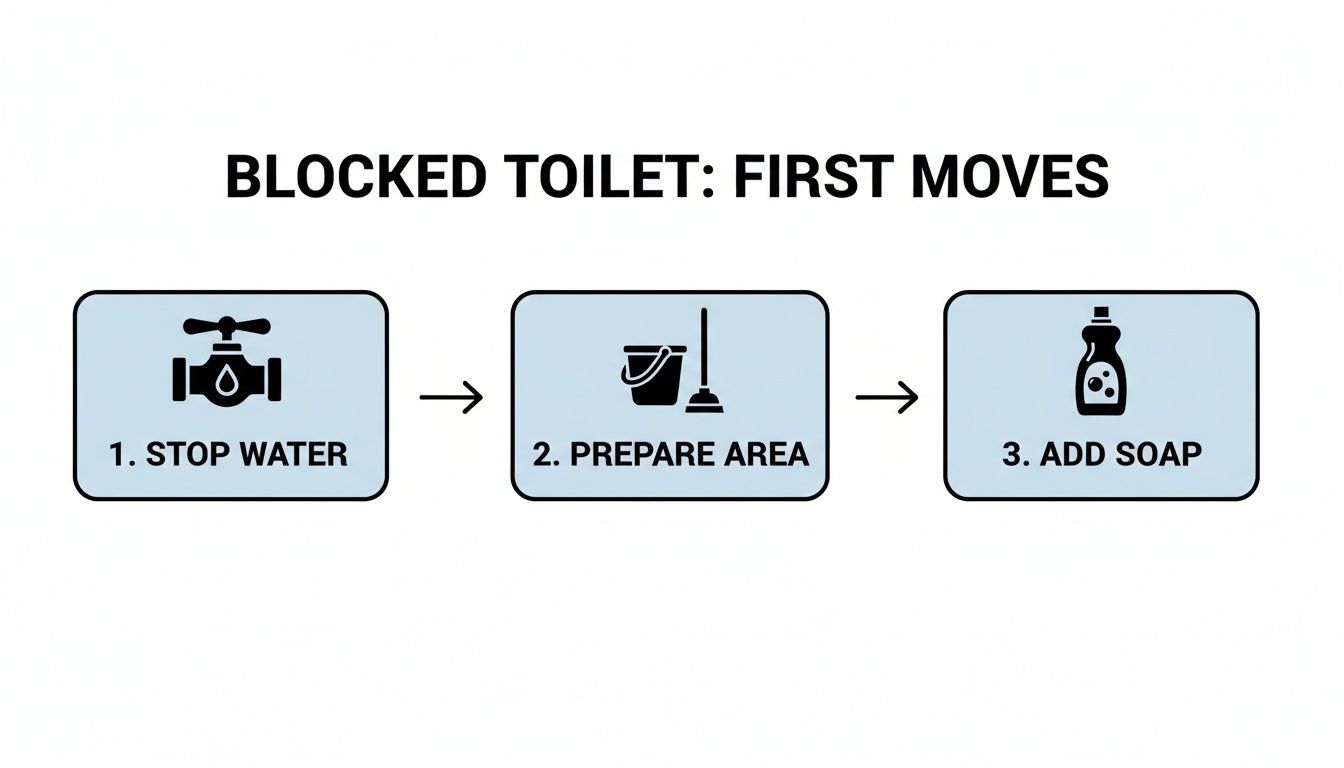
Your First Moves When Facing a Blocked Toilet
That moment of panic when you flush and the water keeps rising is stressful. But before you reach for harsh chemicals or start frantically poking at it, a few calm, deliberate steps can stop a small plumbing issue from becoming a full-blown bathroom disaster. What you do in these first few seconds is critical.
Getting these initial moves right sets you up for a successful DIY fix, letting you handle the immediate crisis safely and get things flowing again.
Stop the Water to Prevent an Overflow
First things first: stop more water from getting into the bowl. Your absolute number one priority is preventing a flood.
The fastest way is to lift the lid off the cistern (the tank at the back) and manually push down on the flapper valve. It’s that rubber disc at the bottom. Closing it with your hand will immediately stop water from the tank refilling the bowl. It buys you precious time to think.
Once you've stopped the immediate flow, find the water supply valve on the wall, usually behind or next to the toilet. It’s a small, oval-shaped tap. Turn it clockwise all the way until it stops. This cuts the water off completely.
Prepare the Bathroom and Protect Your Space
Before you get your hands dirty, take a minute to prep the area. Trust me, this small step will save you a massive clean-up job later.
- Lay down some old towels or a stack of newspapers around the base of the toilet. Things can get splashy.
- Get some air circulating. Open a window or switch on the exhaust fan.
- Grab a pair of rubber gloves. You want to protect your hands from all the nasty bacteria.
This isn't just about containing a potential mess; it's about creating a safer, more hygienic space to work in.
The Hot Water and Dish Soap Method
For minor clogs, especially those from too much toilet paper, this gentle method is surprisingly effective. It's the perfect first move if you don't have a plunger handy.
Pro Tip: I can't stress this enough – hot, not boiling. Pouring boiling water into a cold ceramic toilet can cause thermal shock and crack the bowl. It's a costly mistake and one you really want to avoid.
Start by squirting a decent amount of liquid dish soap into the toilet bowl – about half a cup should do it. The soap helps lubricate everything and break down any greasy stuff, making it easier for the clog to move along.
Now, heat up about four litres of water. You want it to be about the temperature of a hot cuppa—very warm, but not scalding. Carefully pour it into the bowl from about waist height. The height adds a bit of force, and combined with the heat and soap, it can work wonders to dissolve the blockage.
Leave it all to sit for at least 20-30 minutes. You should start to see the water level drop as the clog breaks down. Sometimes, a toilet that has a weak or incomplete flush (something we cover in our guide on what to do when your toilet won’t flush properly) just needs this little bit of help. After you've waited, give it a flush. If the water goes down, you're all clear. If not, don't worry – it's time to bring out the plunger.
Quick Guide to DIY Toilet Unblocking Methods
When you're faced with a blocked loo, it helps to know which tool is right for the job. Not all DIY methods are created equal. Here’s a quick rundown of the most common approaches to help you decide where to start.
| Method | Success Rate (Minor Clogs) | Required Tools | Best For |
|---|---|---|---|
| Hot Water & Dish Soap | High | Dish Soap, Hot Water | Soft blockages like excess toilet paper or organic waste. |
| Plunger | Very High | Flange Plunger | Most common clogs located in the toilet's S-trap. |
| Toilet Auger (Snake) | Excellent | Toilet Auger | Stubborn or deep clogs that a plunger can't reach. |
| Baking Soda & Vinegar | Moderate | Baking Soda, Vinegar | Minor organic clogs; good for maintenance and deodorising. |
Each of these methods has its place. Starting with the gentlest option—hot water and soap—is always a smart first step. If that doesn't work, you can confidently move up to the more robust tools like a plunger or auger, knowing you've given the simpler fixes a fair go.
Using a Plunger Like a Professional
When hot water and soap don't quite get the job done, the plunger is your next best friend. But there’s a bit of an art to it. Just ramming it into the bowl and hoping for the best is a recipe for a wet floor and a still-blocked loo. What we’re really doing here is using hydraulic pressure to shift the blockage, not just brute force.
First things first, you need the right tool. That standard cup plunger you have for the sink? It’s not going to cut it here. For a toilet, you need a flange plunger. It has an extra bit of rubber that folds out to create a perfect seal in the toilet's drain opening. Without that seal, you're just splashing water around.
That little flange makes all the difference between a frustrating mess and a clear drain.
Mastering the Plunging Technique
Before you even start, check the water level in the bowl. The rubber head of the plunger needs to be completely submerged to work properly. If it’s too low, just add a bit of water from a bucket. Remember, you're moving water to dislodge the clog, not air.
Now, position the plunger so that the flange fits snugly into the drain. Your first push should be gentle – this is just to get rid of any trapped air under the cup and avoid a nasty splashback.
Once you’ve got a good seal, it's time for the real work. The key is a rhythmic push-and-pull motion.
Here's the pro secret: the real magic happens on the pull stroke. When you pull the plunger back up, you’re creating a powerful vacuum that yanks the blockage loose. This is way more effective than just trying to force it down the pipe. Keep this vigorous motion going for about 20-30 seconds.
After a solid round of plunging, break the seal and see what happens. If the water starts to drain, fantastic! You're done. If it’s still stuck, don't give up. It can sometimes take a few rounds to convince a stubborn clog to move.
A Couple of Insider Tips
If you're dealing with a particularly tough blockage, here are a couple of tricks we use in the field to give the plunger a bit more oomph.
- Boost the Suction: Block the overflow drains in any nearby sinks or tubs with a wet rag. This stops the pressure you're building from escaping elsewhere, focusing it all right where you need it – on the clog.
- Lubricate the Plunger: A little smear of petroleum jelly around the plunger's rim can help create a super-tight seal against the porcelain bowl.
These little adjustments can make a huge difference. And keep in mind, if you're frequently dealing with slow drains all over the house, it might be a sign of a bigger problem further down the line. We cover this in more detail in our guide on how to clear blocked drains.
Of course, sometimes a plunger just isn't enough. If the water level refuses to budge after several attempts, or if you think something hard (like a child's toy) is down there, it's time to stop. Forcing it could damage your pipes. A local expert like a plumber in Balwyn North can diagnose the issue safely. The next step would be to try a toilet auger.
Stepping Up to a Toilet Auger for a Stubborn Clog
Right, so you’ve given the plunger a fair go and that water level just isn't budging. It’s time to call in the big guns of DIY plumbing: the toilet auger.
Often called a plumbing snake, this tool is your best bet for blockages that are either too deep or too compacted for a plunger to handle. If you suspect the culprit is more than just excess paper—think flushed wet wipes, sanitary products, or even a small toy that's gone on an adventure—the auger is what you need.
A proper toilet auger is different from a standard drain snake. It has a crucial feature: a protective rubber sleeve on the curve that goes into the bowl. This is non-negotiable, as it’s what stops you from scratching and damaging the porcelain.
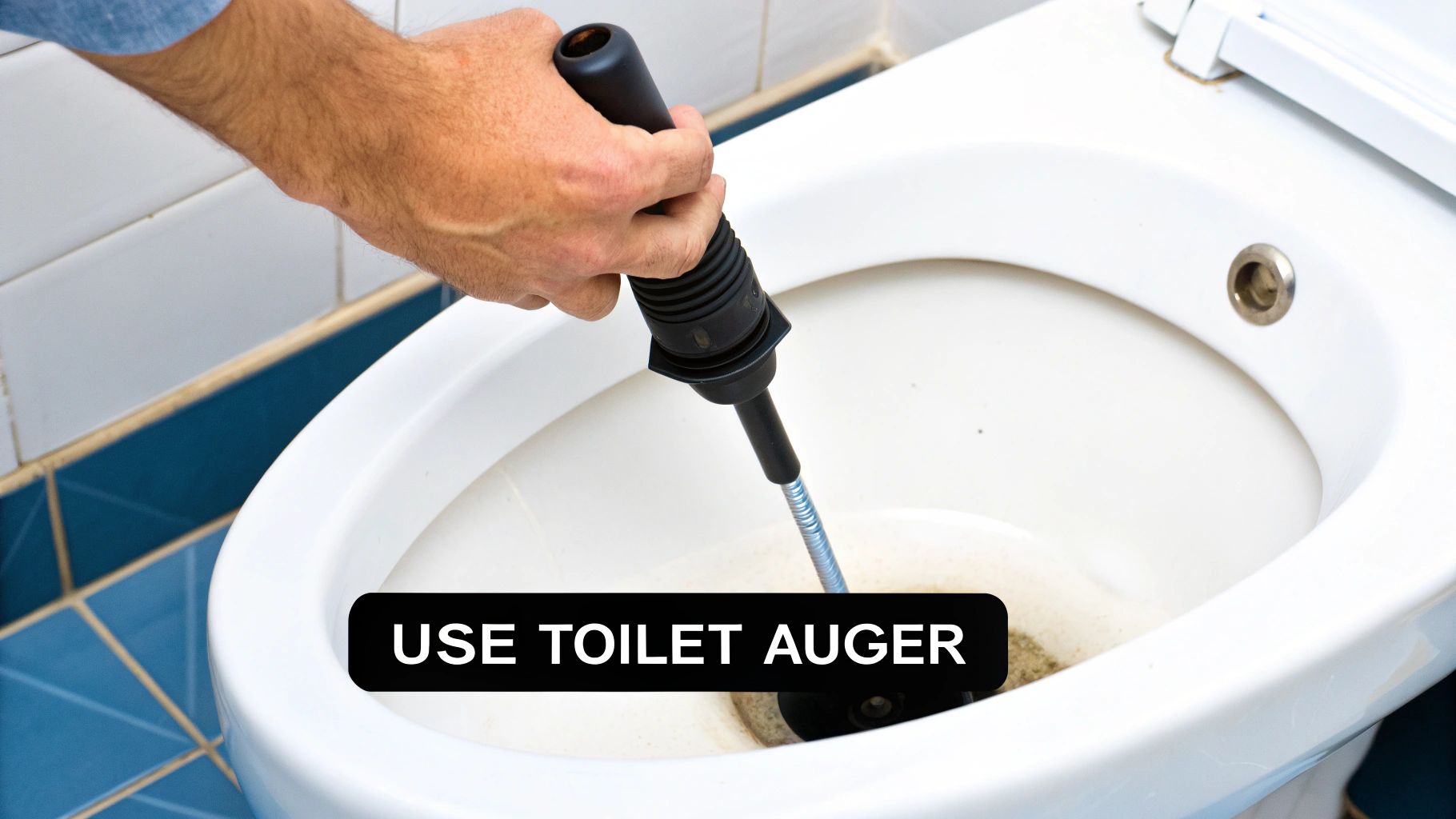
Getting the Hang of the Auger
Using a toilet auger looks more intimidating than it is. The whole idea is to feed a flexible cable down through the toilet’s S-trap to either smash up the clog or hook it and pull it back out. Just take it slow.
Start by placing the curved, rubber-protected end into the bottom of the toilet bowl, making sure the cable end is pointing right into the drain opening. Get that protective guard sitting firmly against the porcelain. Hold the main handle steady with one hand.
Now, with your other hand, start slowly turning the crank handle clockwise. This feeds the cable into the drain. You'll need to apply a bit of gentle, consistent pressure to help guide it around the tight bends of the toilet's internal trap.
Hitting the Blockage
Keep cranking, and eventually, you'll feel some resistance. That’s it—you've found the blockage. Whatever you do, don't try to brute force it. Jamming it too hard can kink the cable or get it hopelessly stuck.
Instead, keep turning the crank while gently pushing and pulling the auger.
This gentle push-pull and rotating motion is the key to success. The corkscrew tip of the auger is designed to work like a drill, breaking apart soft obstructions, or to snag onto solid items like a hook. A big clump of wet wipes will likely get torn apart, while a more solid object will hopefully get snagged.
Once you feel the resistance suddenly give way or lessen, you've either punched through the clog or hooked onto it.
Bringing it Home: Retracting the Auger
Time to bring the cable back. Simply start turning the crank handle in the other direction (counter-clockwise). Again, go slowly and don't yank it. If you've snagged something, you'll feel the tension as you pull it back towards the bowl.
Once the cable is fully retracted inside the auger's shaft, you can lift the whole tool carefully out of the toilet. If you've pulled out the source of the blockage, fantastic! Just be sure to throw it in the bin, not back into the toilet.
If you think you just broke the clog apart, the water level might already be dropping. Give the toilet a single flush to see if it clears. If it drains like normal, job done. If it's still a bit slow, you might need to give it one more go with the auger.
An auger is a brilliant tool, but it's usually the last stop on the DIY train. If a toilet auger can't shift the blockage, it’s a strong sign the problem is more serious and located further down the plumbing line. Pushing your luck at this point could make things worse.
This is the moment to call in the professionals. Whether you need a plumber in Doncaster or a plumber in Balwyn, a stubborn clog like this needs an expert eye. Don't hesitate to contact us for a fixed-price quote to get your pipes flowing freely again.
Right, so you've just wrestled with a blocked toilet and come out victorious. You definitely don't want a rematch anytime soon. Honestly, the absolute best way to "unblock" a toilet is to make sure it never gets blocked in the first place. A few simple changes in habit can save you a mountain of stress, mess, and money down the line.
The first step is understanding what's actually causing the blockage. It’s rarely one single flush that does it. More often than not, it's a slow, steady build-up of things that simply had no business being in your pipes. Here in Melbourne, we see the same culprits time and time again.
The Great 'Flushable' Myth & The Three Ps Rule
By far, the biggest cause of blocked drains is people flushing things that just don't belong in the sewer system. The word "flushable" on a packet of wipes is one of the most misleading marketing terms out there. Unlike toilet paper, which is specifically designed to dissolve quickly in water, these other items are built to be tough.
Let's be blunt: those so-called "flushable" wipes are the number one villain behind sewer blockages across Australia. They're engineered not to fall apart, meaning they twist into stubborn, rope-like clogs that grab onto everything else, creating a nightmare backup.
This is where the simple 'Three Ps' rule is a lifesaver. It’s an easy one to teach the whole family: the only things that should ever be flushed are Pee, Poo, and (toilet) Paper.
Here's a quick list of what should never go down the loo:
- Wet Wipes: Baby wipes, makeup wipes, cleaning wipes… all of them. Even if the packet says they're flushable, they are not.
- Paper Towels & Tissues: These are made to be strong and absorbent, which is the exact opposite of what you want in your pipes.
- Sanitary Products: Tampons and pads are designed to expand, which is a recipe for an instant blockage.
- Dental Floss: It’s like sending a tiny, strong net down your drain, ready to catch and tangle with waste.
- Cotton Balls & Q-tips: These don't dissolve; they just clump together into a solid mass.
Research from Sydney Water really puts this into perspective, showing that a whopping 75% of all sewer blockages involve flushed wet wipes. It's a clear sign that prevention is the most powerful tool you have. You can read more about this national plumbing headache and how it affects homeowners all over the country.
Less Obvious Reasons for Recurring Clogs
If you're already following the 'Three Ps' rule but still find yourself reaching for the plunger, there might be something else going on.
Too Much Toilet Paper
Yes, it's designed to be flushed, but using half a roll in one go can still overwhelm the system. A massive wad of paper simply can't break down with the water from a single flush, leading to a soft but very effective clog. A good rule of thumb is to use a moderate amount and, if needed, do a "courtesy flush" part-way through.
Older Low-Flow Toilets
Those first-generation low-flow toilets from the 90s were well-intentioned but often lacked the oomph needed to get the job done. While modern water-saving toilets are fantastic, these older models can struggle to push waste fully through the S-trap and down the line. If you've got an older toilet and frequent clogs, the fixture itself could be the weak link.
Deeper Problems in Your Plumbing
Sometimes, the blockage you see in the bowl is just a symptom of a much bigger problem lurking further down the drain line. If you're constantly dealing with clogs, no amount of plunging is going to fix an underlying issue.
Here’s what could be happening out of sight:
- Tree Root Intrusion: Tiny roots can sneak into older pipes through small cracks and grow into a dense mat that catches everything that passes by.
- Damaged or Collapsed Pipes: Especially common in older properties, clay pipes can crack, shift, or collapse over time, creating a serious bottleneck.
- Blocked Vents: Your plumbing system needs airflow to drain properly. A blocked vent stack can create a vacuum, slowing everything down and leading to clogs.
If you suspect a deeper issue is at play, you might be looking at more advanced solutions like pipe relining for older Melbourne homes, which essentially builds a brand-new pipe inside the old, damaged one.
When the clogs just keep coming back, it’s time to stop guessing. Don’t let a recurring hassle turn into a plumbing disaster. For a professional diagnosis and a real, long-term solution, contact Amari Plumbing and Gasfitting today.
Knowing When to Call a Melbourne Plumber
While tackling a blocked toilet yourself can be satisfying, there comes a point where persistence can backfire, turning a minor hassle into a full-blown plumbing disaster. Knowing when to trade the plunger for the phone is just as important as knowing how to use it in the first place.
Often, a stubborn clog is just the tip of the iceberg—a symptom of a much deeper, more complex problem lurking in your pipes. Ignoring the warning signs while hoping for a miracle can lead to cracked porcelain, damaged pipes, or even a sewage backup. A bit of DIY is fantastic, but the smartest move you can make is recognising when you're out of your depth.
Red Flags That Signal a Deeper Problem
Sometimes, your toilet will tell you exactly when it's time to call in the experts. These aren't subtle hints; they're clear warnings that the blockage is beyond the reach of a plunger or a basic auger.
If you spot any of the following, it's a huge sign the problem is further down the drain line:
- Recurring Blockages: Is your toilet clogging up every few weeks, no matter how careful you are? This is the number one indicator of an underlying issue, like a partial obstruction in the main drain or the beginnings of tree root intrusion.
- Gurgling Drains: Hear strange gurgling sounds from your shower or sink drains when you flush the toilet? That’s trapped air being forced back up through the system because a downstream blockage is preventing it from escaping properly.
- Water Backing Up Elsewhere: If flushing the toilet makes water appear in your shower or bathtub, stop immediately. This points to a blockage in the main sewer line, and adding any more water will only guarantee a messy overflow.
- A Persistent Foul Smell: A lingering sewer gas odour that just won't go away often signals a problem with your drain lines or the venting system.
The Risk of Pushing a Clog Further Down
One of the biggest dangers of getting too aggressive with a DIY approach is accidentally making things much worse. When you try to force a clog with a plunger or auger, you risk shoving a dense mass out of the toilet's S-trap and into the main sewer line. This can transform a simple, local blockage into a major obstruction that’s far more difficult and expensive to clear.
A study of Australian plumbing emergencies found that over 60% of residential toilet blockages are caused by flushing non-flushable items like wipes and sanitary products. When these items get pushed deeper, they can create serious blockages far from the toilet itself.
What to Expect from a Professional Plumber
When you call a team like Amari Plumbing, you’re not just getting someone with a bigger plunger. We show up with advanced diagnostic and clearing technology. We start with high-definition CCTV drain cameras to see exactly what’s causing the clog and pinpoint its location. It completely removes the guesswork.
Once we’ve identified the culprit—whether it’s tree roots, a solid mass of wet wipes, or even a collapsed pipe—we bring out the high-pressure water jetters. These powerful tools use a focused blast of water to obliterate the blockage and scour the pipe walls clean. This restores full flow and helps prevent the same issue from happening again, delivering a level of clean no DIY tool can ever achieve.
If you're dealing with a stubborn blockage that won’t budge, or if the problem keeps coming back at the worst possible times, don't hesitate. Knowing what to do when you need after-hours plumbing support can save you from a world of stress and property damage. For immediate, expert help with any blocked drain in Melbourne, contact Amari Plumbing and Gasfitting for a fast, fixed-price solution.
Your Blocked Toilet Questions, Answered
When your toilet won't flush, panic often sets in, followed by a lot of questions. As plumbers who’ve seen it all across Melbourne's eastern suburbs, we get it. Here are some straight answers to the most common things we get asked.
Are Those Chemical Drain Cleaners a Good Idea?
Honestly? We’d give them a hard pass. Pouring harsh chemicals down your toilet is a bit of a gamble. The aggressive reaction they cause can generate enough heat to actually crack the porcelain of your toilet bowl or damage the PVC pipes underneath.
Even worse, if the chemicals don't clear the blockage, you’re left with a toilet bowl full of toxic, hazardous sludge. That's a serious safety risk for you and for any plumber who has to tackle the problem afterwards. A simple toilet auger is a much safer, and usually more effective, bet.
Is the Problem Just My Toilet, or Is It the Main Sewer Line?
This is a great question, and there's a simple way to get a good idea of what's going on. Take a look at the other drains in your house.
If it's just the one toilet playing up while your sinks and showers are draining perfectly, the culprit is likely a simple blockage in that toilet's S-trap. But if you're seeing slow drains all over the house, or flushing the toilet makes water gurgle up in the shower, you're almost certainly looking at a main sewer line blockage. That's a much bigger issue and needs a professional plumber, fast.
Help! I Flushed Something Valuable Down the Toilet.
First things first: do not flush it again. Whatever you've dropped, whether it's a wedding ring or an earring, is probably just sitting in the S-bend at the base of the toilet. One more flush could send it into the main sewer line for good.
Start by turning off the water supply to the toilet using the small tap on the wall behind it. If you have a wet/dry vac, you can try using it to suck the water (and hopefully the item) out of the bowl. If that doesn't work, the toilet itself will need to be unbolted and removed to get at the trap. This is a job best left to a pro to avoid a messy, leaky disaster when you put it back.
Why Does My Toilet Keep Blocking Up?
If you feel like you're constantly reaching for the plunger, it's a clear sign of an underlying issue. It could be something straightforward, like a family member being a bit too generous with the toilet paper. Or, it could be a symptom of a much larger problem.
Recurring blockages are your plumbing system's way of telling you something is wrong further down the line. Ignoring it is like ignoring the check engine light in your car—the problem will only get worse.
Often, we find that older, first-generation low-flow toilets just don't have the oomph to clear the bowl properly. In other cases, the problem is deeper in the pipes—things like tree roots creeping into the line or even a partially collapsed drain. These issues can escalate, as seen when a public toilet block on Russell Island, Queensland, overflowed from a build-up of simple wrappers and paper. You can read more about this public plumbing incident to see how serious it can get. A professional diagnosis is the only way to find the real cause and fix it for good.
Tired of battling a stubborn toilet or facing a full-blown plumbing emergency? Amari Plumbing and Gasfitting is ready to help. Our team delivers fast, reliable, and affordable solutions for blocked drains right across Melbourne. For an upfront, fixed-price quote and expert service you can count on, contact us today.